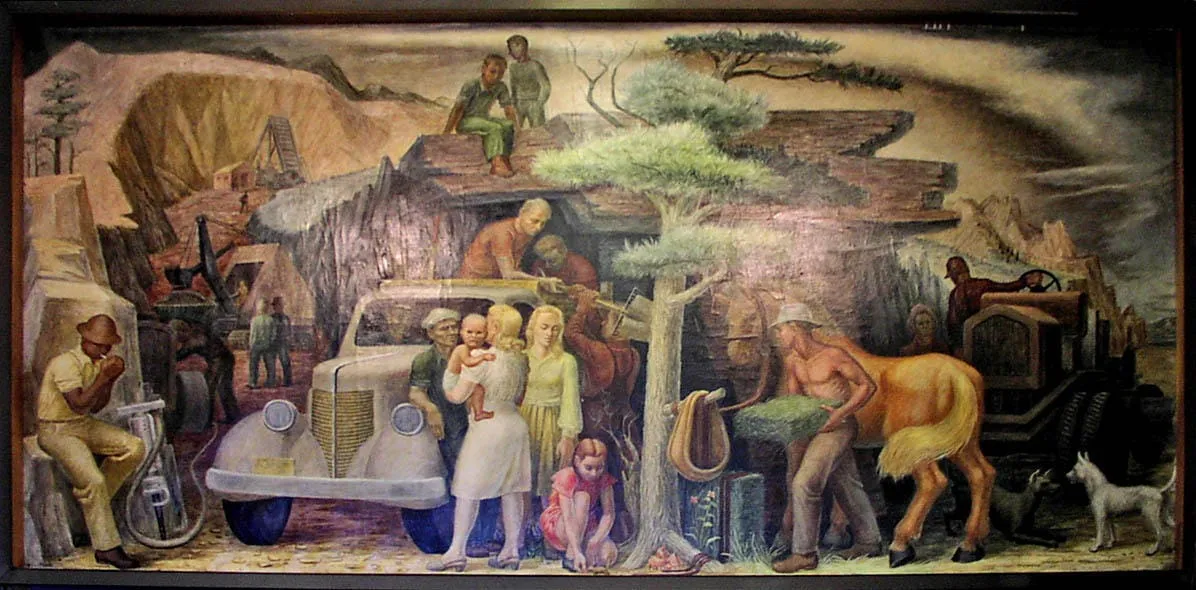
Roosevelt's New Deal brought about many positive changes in the Golden area. Several of the construction projects are still with us, including Berthoud Hall and Steinhauer Field House on the Mines campus, the downtown post office, and Red Rocks Amphitheater.
I always enjoy reading about the lesser-known projects.
The Sewing Project employed women to produce clothing and bedding for the poor, aged, and infirm. Occasionally they were called upon to do special projects, such as sewing costumes for theater programs or making doll clothes as Christmas presents for needy children. The sewing room was set up in the old North School, at 6th and Washington.
School lunch programs came about through the WPA, which paid to install kitchens in schools and employed women to work in them. The lunches were initially intended to help “under-nourished” children.
Adult education classes in Golden included music, drama, arts & crafts, gym, swimming, shorthand, business English, bookkeeping, typing, dance, metalworking, leatherworking, and first aid. Classes were offered in schools, the Armory, and at Camp George West.
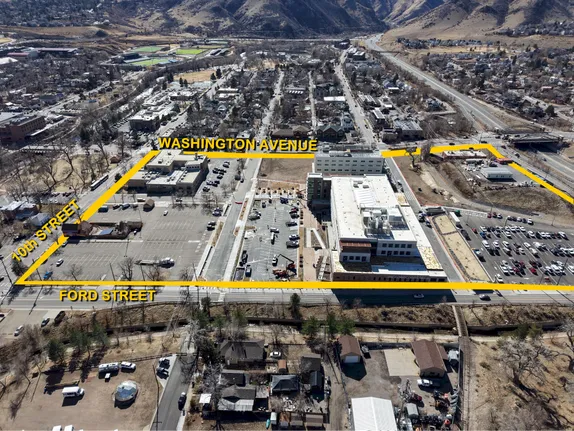
Canning centers preserved food for area farmers on a “share” basis. Farmers brought their produce to the canning centers. Fruit was processed with 75% being returned to the farmer and 25% being used to feed under-nourished school children. Vegetables were shared with 2/3 going to the farmer and 1/3 going to the schools. One canning center was set up in the Burgess House, at Ford & Water Streets.
One of the most popular offerings with Golden home-owners was the curb and gutter program sponsored by Golden’s Mayor Burt Jones. WPA workers installed curbs and gutters in front of homes at a cost to homeowners of 36 cents per foot. This resulted in government covering about 75% of the cost.
Summer camps for children offered supervised recreation and arts & crafts in Parfet Park and City Park (which is now gone).
Republicans tended to dismiss WPA programs as a waste of taxpayer money, and WPA workers as lazy and inept. Ever the Democratic newspaper, the Transcript always defended the WPA. They pointed out that Republicans had passed the Homestead Act.
IT WASN’T CALLED A DOLE THEN
But giving farms to deserving people didn’t suit the Republicans–it didn’t get rid of the public’s domain fast enough, so they gave to the railroads every alternate square mile for 10 miles each side of the tracks. These same Republicans tried to turn over all the oil lands to their gang but got caught–the teapot boiled over.
Colorado Transcript, Number 50, October 14, 1943