54 Years Ago
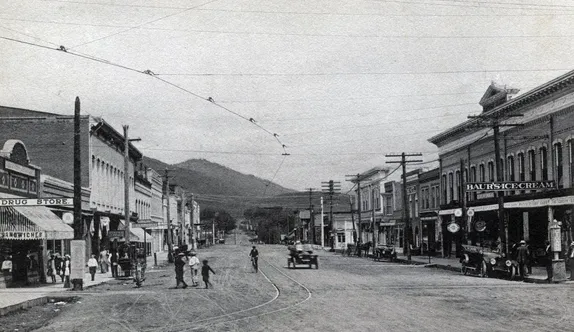
In 1971, downtown Golden was struggling. Customers were flocking to shopping malls such as Westland and Villa Italia, and traditional downtown districts were feeling their loss.
Huge, free parking lots were part of the attraction of shopping malls. Golden’s merchants and City Council had an ongoing campaign to increase available parking. When the owner of the Astor House—which had been built in 1867—offered to sell it to the City (so they could demolish it and create another parking lot), they accepted the offer.
The August 13, 1971 Golden Transcript reviewed City Council’s recent discussion regarding the building. Only one councilor hesitated about the decision. Ruben Hartmeister suggested that the building could be used as a museum and community center. He said that the Downtown Improvement District (which was made up of City Councilors) “had obligations beyond parking alone.” However, none of the other councilors agreed with his viewpoint.
Based on this conversation, the Transcript reported that, “the Astor House definitely will be torn down to make way for a parking lot.”
It seemed that the issue was settled, but a group of citizens subsequently took up the cause, built community support, and in the end the citizens of Golden voted to preserve the building.
At that same meeting, Council decided not to submit a bid to buy the Armory building. The state was putting it up for auction, with a minimum bid of $40,000.
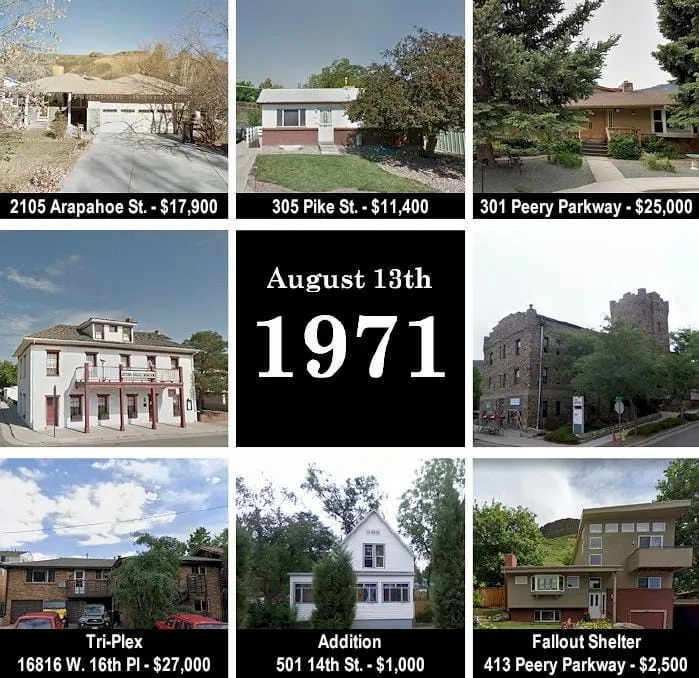
While downtown was struggling, Golden’s residential neighborhoods were expanding. The August 13th Transcript also included a brief article listing recently-approved building permits. Three single-family homes had been approved (2105 Arapahoe St. – $17,900, 305 Pike St. – $11,400, and 301 Peery Parkway – $25,000), as well as one tri-plex (16816 W. 16th Pl – $27,000), one addition (501 14th St. – $1,000), and one fallout shelter (413 Peery Parkway – $2,500).