By Tom Schweich
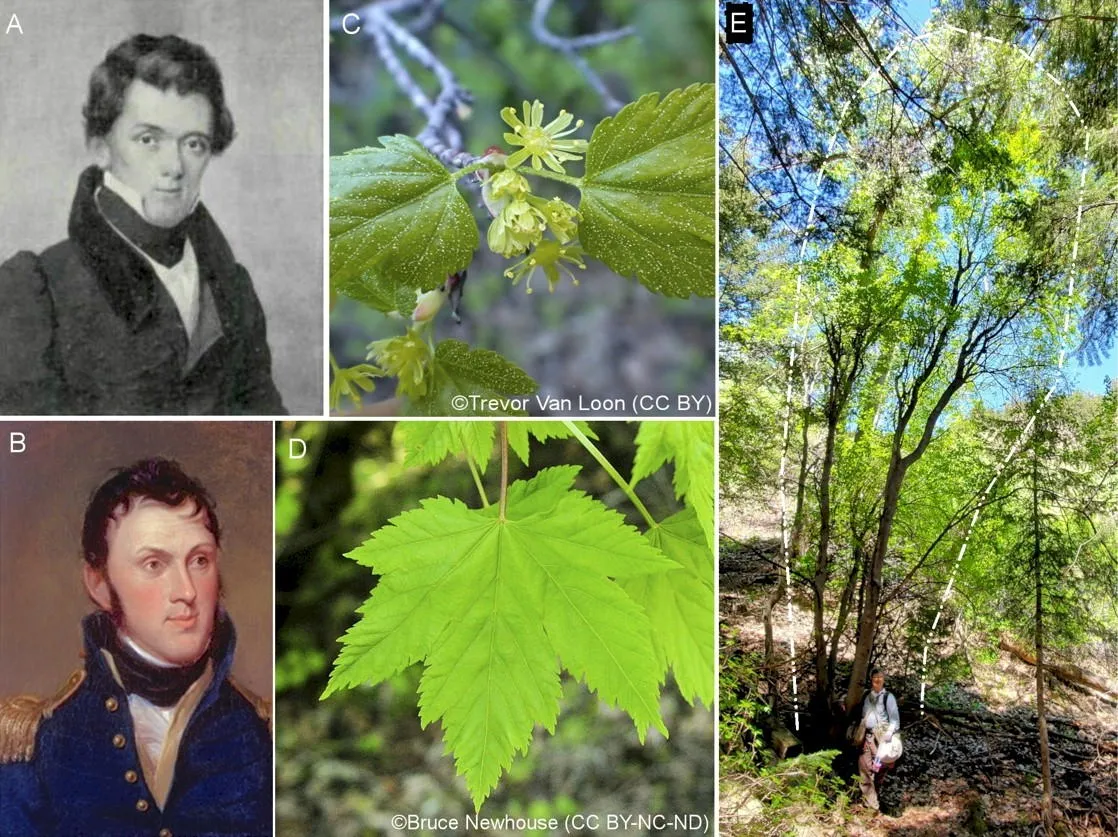
Of the trees native to Golden, my favorite is Rocky Mountain maple — Acer glabrum Torrey — in part because of its deep connection to Jefferson County. In 1820, the Stephen H. Long Expedition followed the South Platte River to the base of the Front Range, then pushed up what is now Platte Canyon. Near the present-day boundary of Jefferson County, the expedition’s botanist, Edwin James, collected a small maple unknown to science at the time. That plant was later named Rocky Mountain maple.
Knowing that this species was first documented here, in our own foothills, I added one to my yard.
Around Golden, Rocky Mountain maple has been found on North and South Table Mountains, Mount Galbraith, and in the mouth of Clear Creek Canyon. It prefers ravines, north-facing slopes, riparian edges, or other sites with concentrated water runoff.
Rocky Mountain maple is usually 15–25 feet tall, though it can grow to 30–40 feet in ideal canyon conditions. Often multi-stemmed, the trunk diameter is typically modest (6–12 inches, occasionally more) so it is not a towering tree like sugar maple. In full sun our tree will grow more like a large shrub. Rocky Mountain maples turn yellow, orange or occasionally red, bringing fall color to the garden.
In Colorado urban gardens, Rocky Mountain maple offers native genetics, support for local food webs, structural diversity, and appropriate size for smaller lots. Maples in general support caterpillars of many moths and butterflies (Tallamy, 2007) though there is little specific research about Rocky Mountain maple. Generally, native trees host the insects that evolved with them. Those insects feed birds. For birds, Rocky Mountain maple provides nesting sites in dense multi-stem growth, cover from predators, and seeds for small birds to eat (Lackschewitz 1991). Finally, multi-stemmed shrubs/small trees are often underrepresented in urban forestry plans, yet they create vertical layering, provide mid-canopy habitat, and increase structural diversity.
In an urban setting, Rocky Mountain maple is not a xeric street tree. It will require supplemental irrigation in typical urban landscapes. It would be best suited to swales, rain gardens. north or east exposures, and landscapes already receiving irrigation
Genetically, our Rocky Mountain maple is most closely related to two maples native to Japan, so it may have an Asian origin. However, it is not closely related to the common “Japanese maple” — Acer palmatum Thunb. (Li, et al., 2019).
Rocky Mountain maple is distantly related to the two other native Colorado maples: Acer negundo L, “box elder”, and Acer grandidentatum Nuttall “big-tooth maple.” Box elder is found throughout Colorado and across north America, whereas big-tooth maple is widely distributed around the western US, but in Colorado it is found only in southwest corner of the state.
Rocky Mountain maple was not the only plant collected by Edwin James in Platte Canyon. Among the others were Eriogonum umbellatum Torrey (sulphur flower), Physocarpus monogynus Torrey (mountain ninebark), and likely Cercocarpus montanus Rafinesque (alder-leaf mountain mahogany) and Rubus deliciosus Torrey (Boulder raspberry).
Like Rocky Mountain maple, these are plants first documented from the foothills we now call Jefferson County. They are not just natives of the region — they are part of its botanical history, and they deserve a place in our gardens.
References
Anderson, Michelle D. 2001. Acer glabrum, Rocky Mountain maple. In: Fire Effects Information System. U.S. Department of Agriculture, Forest Service, Rocky Mountain Research Station, Fire Sciences Laboratory. https://research.fs.usda.gov/feis/species-reviews/acegla
Goodman, George J., and Cheryl A. Lawson. 1995. Retracing Major Stephen H. Long's 1820 Expedition. Norman, OK: University of Oklahoma Press, 1995.
James, Edwin. 1820. Acer glabrum. NY16280. Rocky Mountains; 1,000 ft. elev. fr. the plain. Biodiversity occurrence data published by: SEINet - AZ/NM Node. https://swbiodiversity.org/seinet/collections/individual/index.php?occid=6594447
Lackschewitz, Klaus. 1991. Vascular plants of west-central Montana--identification guidebook. Gen. Tech. Rep. INT-227. Ogden, UT: U.S. Department of Agriculture, Forest Service, Intermountain Research Station. 648 p.
Li, Jianhua, et al. 2019. Maple phylogeny and biogeography inferred from phylogenomic data. Journal of Systematics and Evolution. 57(6):594-606.
Tallamy, Douglas W. 2007. Bringing Nature Home: How Native Plants Sustain Wildlife in Our Gardens. Portland, Oregon: Timber Press.