By Tom Schweich
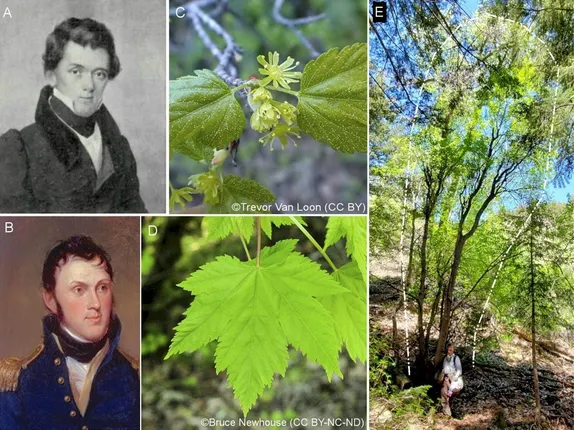
Recently, I wrote about my favorite native maple – Rocky Mountain maple. But Golden has another native maple hiding in plain sight: Acer negundo L., better known as box elder. Despite being a true maple, box elder rarely gets called one. Its common name likely reflects the pale wood’s resemblance to boxwood and the similarity of its compound leaves to those of elderberry.
Box elder is often held in low regard as an ornamental tree. Its brittle limbs break easily, trunks are prone to rot, and it is frequently associated with box elder bugs. The leaves turn a dull yellow and drop over an extended period, along with the winged seeds—contributing to its reputation as a “dirty tree.”
Yet this reputation misses what makes box elder valuable. It tolerates poor soils, grows quickly, and is both drought- and cold-hardy—traits that have made it useful in rural plantings and shelterbelts. More importantly, as a native tree it provides habitat for a wide range of insects, birds, and other wildlife. Many birds and squirrels feed on its seeds (Rosario, 1988).
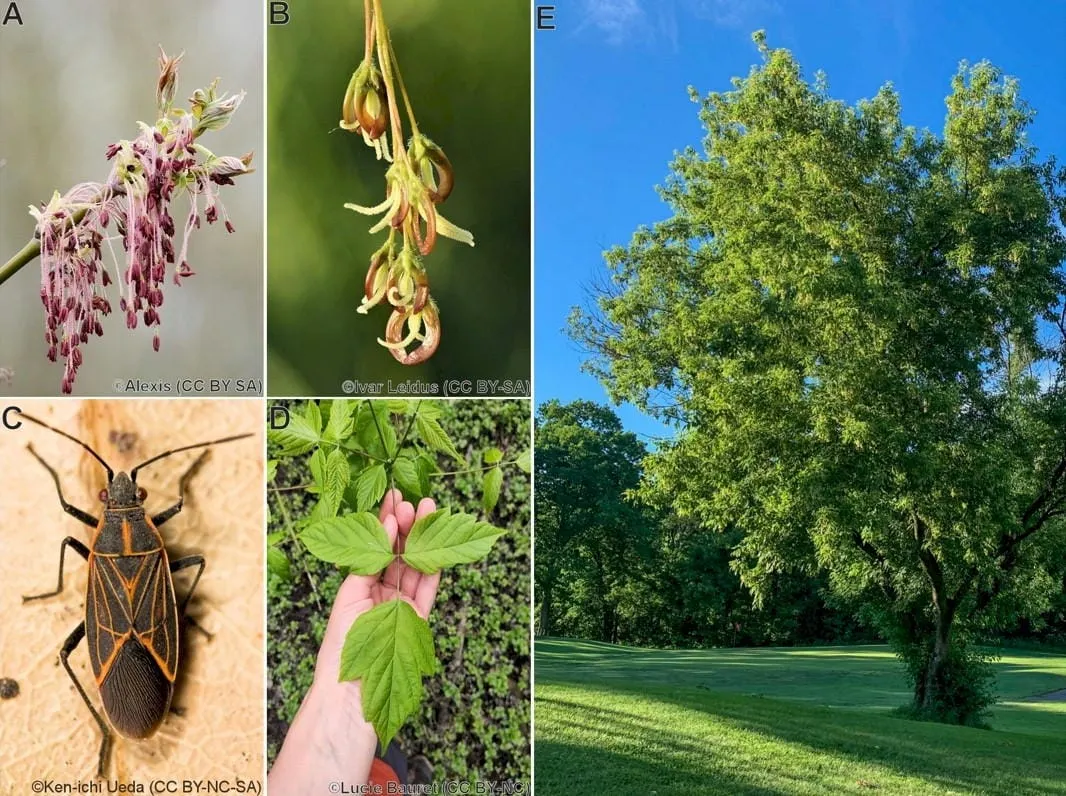
We should also talk about the box elder bugs – Boisea trivittata. They can be a nuisance when they congregate on warm walls during fall. In cold weather they find their way into our houses, but they cause no damage. They primarily eat box elder seeds, and sometimes seeds of other maples and ash trees, but rarely damage the trees. Some birds will eat box elder bugs but they are not a major, preferred food source for most birds. However, box elder bugs are part of a functioning ecosystem and do provide some food value.
While box elder bugs may be the most noticeable insect, they are a minor part of a much larger ecological picture. Box elder supports a suite of native caterpillars that feed baby birds each spring, and native trees like it support far more insect diversity than ornamental non-native species. This ecological value far outweighs the nuisance of box elder bugs.
Box elder is native to North America from Maine to California, and from the Northwest Territories of Canada south to Honduras.
Not surprisingly, with such a wide distribution box elder has a variety of other common names, such as "Manitoba maple," "ash-leaf maple," "cut-leaved maple," "three-leaf maple," "ash maple," "sugar maple," "negundo maple," and "river maple."
The scientific name Acer negundo L. traces to Linnaeus (1753), who reported the species from the Colony of Virginia. However, records show the tree was already being cultivated in London by 1668 (Bean, 1916), indicating it was known to European botanists well before Linnaeus formally described it.
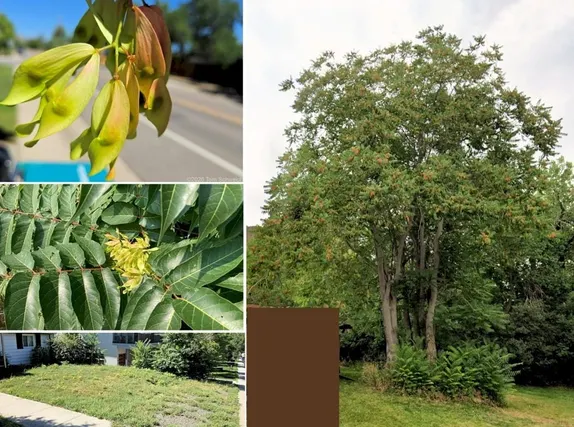
Acer negundo L. is the only species of maple with pinnate compound leaves (Figure 1D) and has sometimes been treated in a separate genus with the name of Negundo aceroides Moench. However, recent phylogenetic data shows that box elder belongs with the maples in genus Acer. And, while maples in general are thought to be Asian in origin, box elder evolved in North America about 25 million years ago (Li, et al., 2019).
Box elders have separate staminate (male) and pistillate (female) trees. The staminate flowers (Figure 1A) on male trees emerge first with the newest leaves. Shortly thereafter the pistillate flowers emerge on female trees (Figure 1B).
Finally, box elder sap contains a substantial amount of sugar and can be made into a pleasant beverage. Plains Indian tribes used it to produce syrup, and it is still used today, though it is less sweet than syrup from sugar maple (Rosario, 1988).
References
Bean, William Jackson. 1916. Trees and Shrubs Hardy in the British Isles, Vol 1, A–C 8th ed. John Murray, London. London: J. Murray, 1916. https://www.biodiversitylibrary.org/bibliography/20825.
Li, Jianhua, et al., 2019. Maple phylogeny and biogeography inferred from phylogenomic data. Journal of Systematics and Evolution. 57(6):594-606. https://onlinelibrary.wiley.com/doi/epdf/10.1111/jse.12535
Linnaeus, Carl. 1753. Species Plantarum. https://www.biodiversitylibrary.org/page/359077#page/498/
Rosario, Lynn C. 1988. Acer negundo. Fire Effects Information System. U.S. Department of Agriculture, Forest Service, Rocky Mountain Research Station, Fire Sciences Laboratory. https://www.fs.usda.gov/database/feis/plants/tree/aceneg/all.html