
By Paul Haseman and Donna Anderson
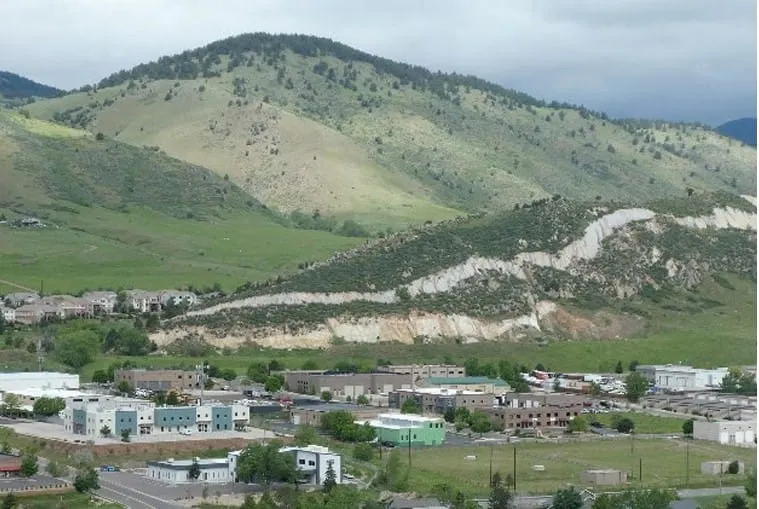
On the north edge of Golden is the “Ribbon of Golden.” Its historical significance is relatively “recent” – the last 120 years (a geologic eye-blink). However, before discussing its importance to Golden’s past and present, a brief look into the long past merits comment.
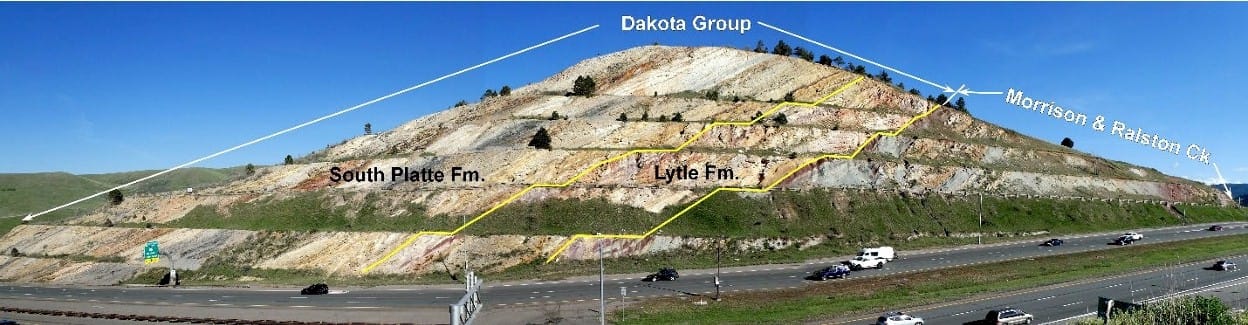
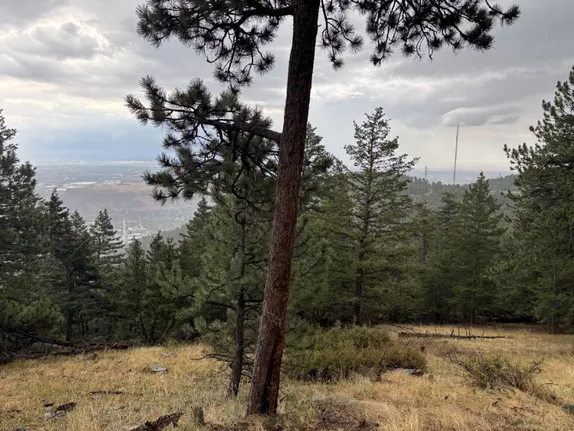
The geology of Golden is, of course, ancient with horizontal rock layers deposited from erosion from the higher Rockies to the west for over 300 Ma (million years ago), e.g., shale, sandstone, limestone, one on top of the other. Deposition slowly came to an end during the “Laramide Uplift” ≈ 68 – 45 Ma, which created the Front Range and then eroded away to the skyline we admire today. The prominent ridge we see daily in Golden is the Dakota Hogback which splits in two sections in Golden. The south half includes Eagle Ridge at the intersection of US 6 and Heritage Road south to the I-70 roadcut (aka Dinosaur Ridge), that thousands of cars pass through daily. The north half is prominent in north Golden where it is part of the North Golden Open Space.
The rocks along the Dakota Hogback were essential to the economy in earlier Golden for its excellent clay; perhaps among the best clay in the U.S per the U.S. Geological Survey. These and other clay deposits provided more than half the clay mined in Colorado before 1953.
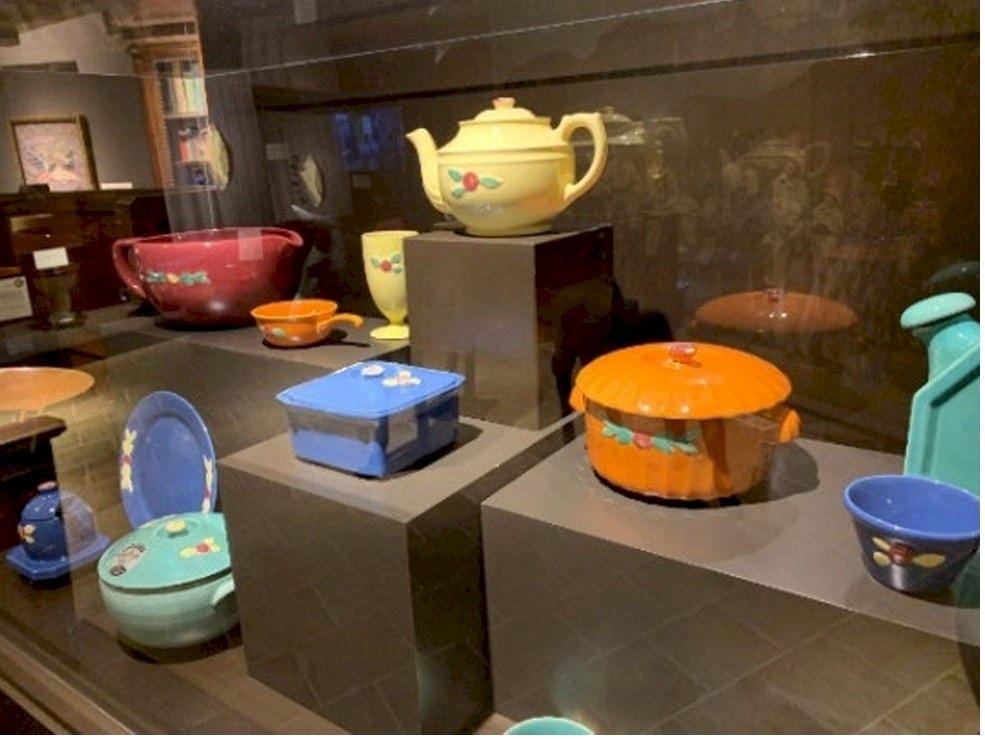
Dakota clay was the basis for the formation of CoorsTek and its fine porcelain products starting in 1910 with the Herold China & Pottery Company, which by 1915 was owned by Adolph Coors. Why did master-brewer Coors care about clay? Well, in 1907 Colorado passed a “Local Option” law that permitted counties to vote to go dry, the forerunner to Prohibition, which Colorado adopted in 1916, four years before National Prohibition. Coors saw the handwriting on the wall and sought to diversify. And a prize-winning porcelain exhibit at the Brown Palace Hotel got his attention. John Herold had moved to Golden in1908 and set up a ceramics shop in an abandoned “pottery” here in Golden. Coors offered him good terms to establish a company, the precursor of today’s CoorsTek, with its world-class porcelain technology. No U.S. satellite is launched today without a part from CoorsTek. High tech, indeed! It all started with a lump of clay.
The white Ribbon of Golden so visible along Highway 93 in north Golden is prominent evidence of this mining. It is the steep wall of sandstone formed by extracting the clay seam in a mining technique known as “stooping,” a lateral “adit” was tunneled into the base of the hogback from the east side of the Hogback. Then the clay was mined laterally from below up to the vertical white sandstone. Over time the remaining unmined clay collapsed revealing the sandstone ribbon.
The Ribbon of Golden is a reminder of both the geology and the part it played in the economic history of Golden.
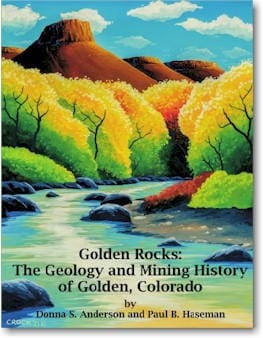
Donna Anderson and Paul Haseman are the authors of Golden Rocks: The Geology and Mining History of Golden, Colorado.
I highly recommend this book. You can buy a copy from the Lulu website, borrow one from the library (there’s a waiting list!), or read it online for free, courtesy of the School of Mines library.