

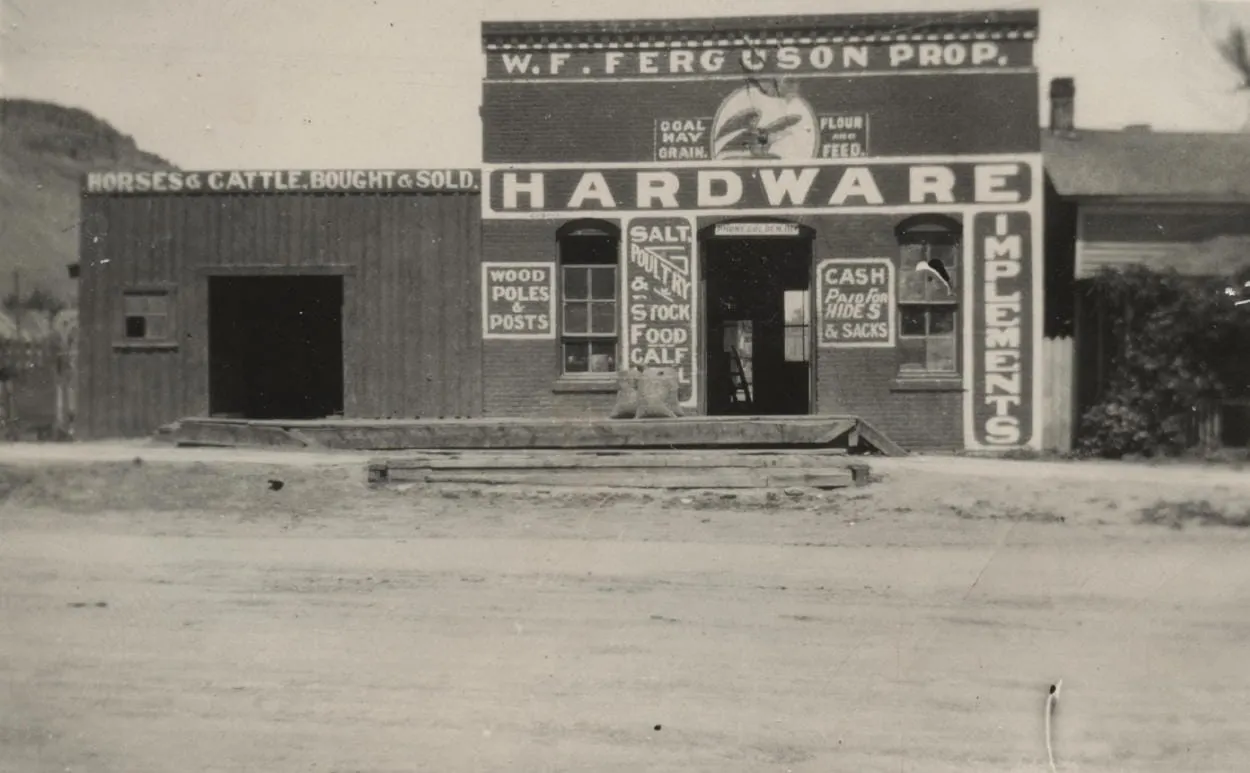
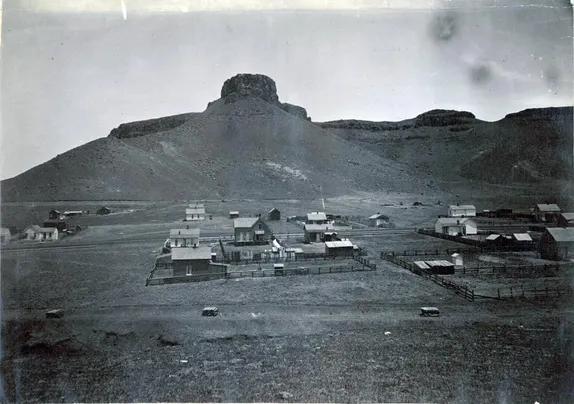
The Eagle Corral, which sold animal field and provided pens for livestock, was a going concern even before the Colorado Transcript published its first issue on December 19, 1866. In fact, that first issue of the Transcript announced a change in ownership:
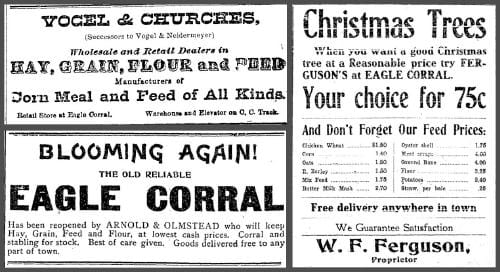
Having taken the Eagle Corral, I am now prepared to accommodate the traveling public in the best manner and at the lowest prices. I will always keep a good supply of Hay, Grain and Feed. — George Hansbrough
The Eagle Corral also provided room and board for many horses. Over its considerable lifespan, the business had several different owners:
1872 – Fred Buckman
1872 – Bailey Brothers
1879 – Smith & Crisman
1885 – Bind & Ward
1893 – Vogel & Niedermeyer
1894 -Vogel & Churches
1901 – Arnold & Olmstead
1905 – Frank Keilbach
1906 – Herman Rathmann
1914 – Guy Buckman
1920 -H.M. Hewins
1920 -Ferguson
The business had two notable fires–one in 1877, in which several small buildings and several tons of baled hay were destroyed, and one in 1921, in which the roof and “a considerable amount of grain and flour” burned. Fortunately, the adjacent hay shed was not damaged. More importantly, the adjacent residence containing the proprietor’s wife and three children was saved, thanks to the Golden Fire Department.
In 1914, owner Herman Rathmann had an unsolicited visit from a "hobo":
City Marshal Scott responded to a “riot call” from the Eagle Corral Saturday night, and found a hobo there standing off the proprietor and several Guy Hill gentlemen, after the latter had tried to force the gentleman of the road to depart in peace. Scott gave the man a night’s rest in sheriff Dennis’ new hotel, and in the morning he was given his choice of leaving Golden or working out a thirty day sentence on the streets. He concluded that Golden’s streets are in good condition now, and left hastily for a sojourn in other parts. — Colorado Transcript, January 29, 1914
By 1920, the town was very interested in building a new high school. This was only partly because the current schools were over-crowded; it was also seen as a way to upgrade the town overall. This was the first year of the Chamber of Commerce’s existence, and they were looking at several ways to modernize and generally improve Golden. Paving the streets and building a new, modern high school in a prominent location were seen as two key steps.

There was debate between people who lived on the north and south sides of the Creek. The north side had traditionally been more industrial and blue collar, while the south side, with the shopping district, the Courthouse, and the School of Mines, considered itself more elite. Northsiders, frankly, were ready to gentrify. They campaigned hard, got their candidate elected to the school board, and were able to secure the planned high school.
The next argument was whether the school should be on the south side of 10th Street–which people were already earmarking for a future park (Parfet Park)–or the north side of 10th Street, which had the Eagle Corral. A 1922 letter to the editor said the corral “has been an eyesore to the city for years.” Others were more restrained but quietly agreed that a business that generated manure had no place on Golden’s main thoroughfare.

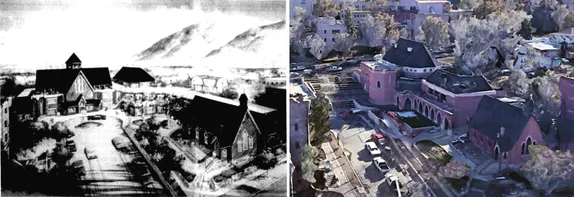
The School District bought the property and dismantled the store, corrals, and storage barns. The Ferguson family’s house was moved to 7th Street in 1922 and the new High School was built on the former location of the Eagle Corral in 1924.



)

