By Tom Schweich
Tomorrow evening (Tuesday, July 8th) our City Council will review the proposed Open Space Master Plan in study session. This is a good plan for Golden. The draft Master Plan provides excellent principles and recommendations for open space planning and management. In addition to hard work by staff and consultants, it incorporates hours of analysis and recommendations by the nine citizens of the Open Space Working Group.
While Golden is deeply embedded in 57,000 acres of Jefferson County Open Space, Golden’s own 391 acres of open space still holds many surprises and deserves special conservation work to preserve the little bit of Golden that is left from before it became a city.
As an example, a week or so ago, I was exploring one of our open spaces. In the head scarp of an ancient landslide was a small wetland. I had thought that the previous five days of sun and heat would have fried the plants. And while some were dried up, others, like the Wild Bergamot, Hairy False Golden Aster, and even the Calochortus (mariposa lilies) were looking quite fresh and blooming exuberantly.
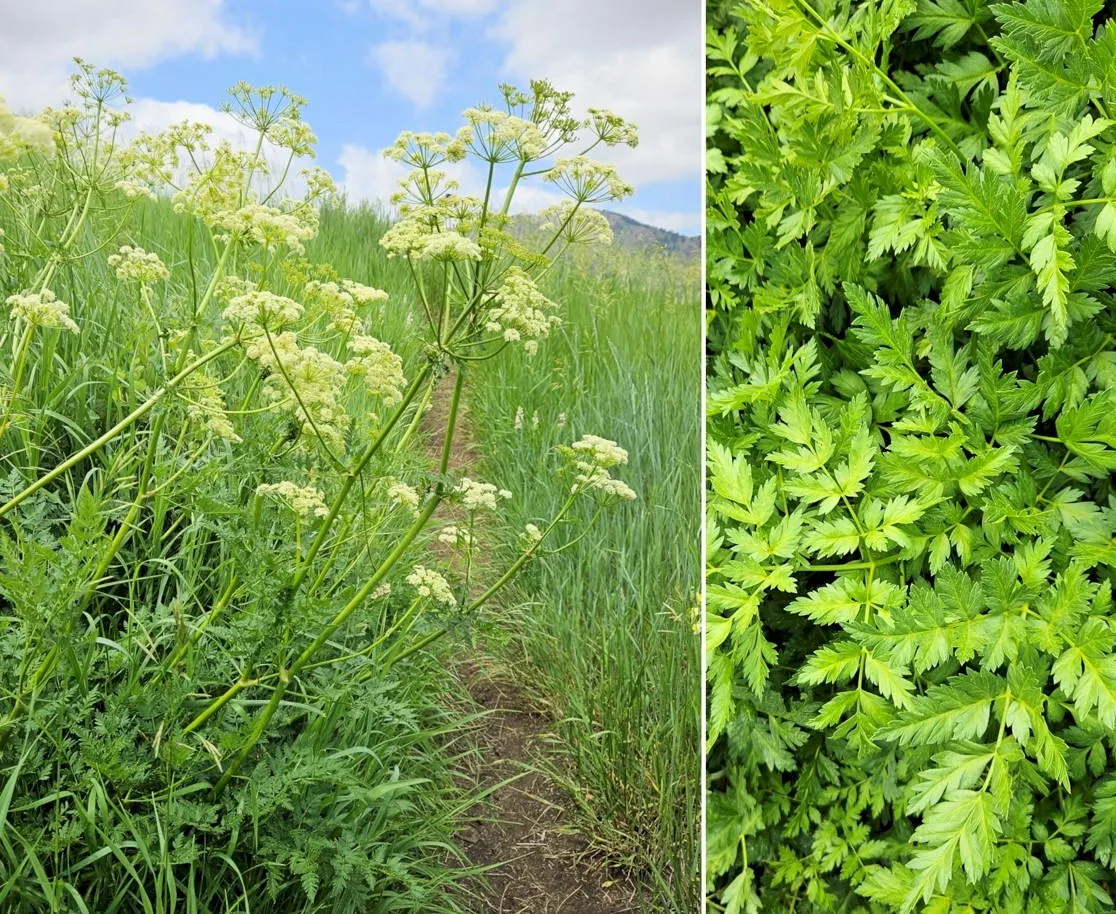
I also found a plant that is a new record for Golden. Ligusticum porteri J.M. Coult. & Rose (1888) is a perennial herb found in parts of the Rocky Mountains and northern New Mexico, in the southwestern United States. One common name for Ligusticum porteri is Osha. It is also known as Porter's lovage, Porter's licorice-root, or Loveroot. Other names include Bear root, Wild parsley, and Chuchupate.
Most descriptions state that osha is strictly a mountain plant, and that it is usually found in deep, moist soils rich in organic material. Yet it thrives in a little oasis hidden in Golden’s open space.
Ligusticum porteri was named for Thomas Conrad Porter (1822–1901), an American botanist and theologian, who worked with the Hayden expedition to Colorado in 1872 and 1873 (Anon., 2025). Porter and John M. Coulter wrote the first book about Colorado Plants, the Synopsis of the Flora of Colorado (Porter & Coulter, 1874), a compilation of descriptions of plants found on various exploring expeditions.
In folk medicine, preparations made of the root of osha are considered an immune booster and aid for coughs, pneumonia, colds, bronchitis, and the flu. Some studies show that substances in the root of osha are bioactive, but there are no studies showing that osha root is safe and effective in humans.
Osha is primarily wild-collected for the herbal supplement market because the plant is difficult to cultivate artificially. This is reducing populations of the plant throughout its range. If harvest continues at current levels the plant is in danger of becoming locally extinct in some areas. NatureServe (2025) evaluates the species as vulnerable (G3) at the global level and vulnerable (S3) in Colorado.
In the field it is essential to distinguish between osha and look-alike herbs in the same family, several of which are highly toxic to humans. One of the herbs frequently mistaken for osha is common poison hemlock – Conium maculatum L. – an introduced weed (Riley, 1870).
References
Anonymous 2025. Hayden's U. S. Geological Survey: Expedition to Colorado (1873). https://naturalhistory.si.edu/research/botany/about/historical-expeditions/haydens-us-geological-survey-colorado
Coulter, John M., and Joseph N. Rose. 1888. Revision of North American Umbelliferae. Crawfordsville, Indiana: Wabash College, 1888. https://www.biodiversitylibrary.org/item/76201
NatureServe. 2025. Ligusticum porteri, Porter’s lovage. https://explorer.natureserve.org/Taxon/ELEMENT_GLOBAL.2.150160/Ligusticum_porteri
Porter, Thomas C., and John M. Coulter. 1874. Synopsis of the Flora of Colorado. Washington: Government Printing Office, March 20, 1874. https://www.biodiversitylibrary.org/item/101470
Riley, Charles V., ed. 1870. Poisonous Plants. The American Entomologist and Botanist. 2(7):220. https://www.biodiversitylibrary.org/page/32620673#page/238/