By Tom Schweich
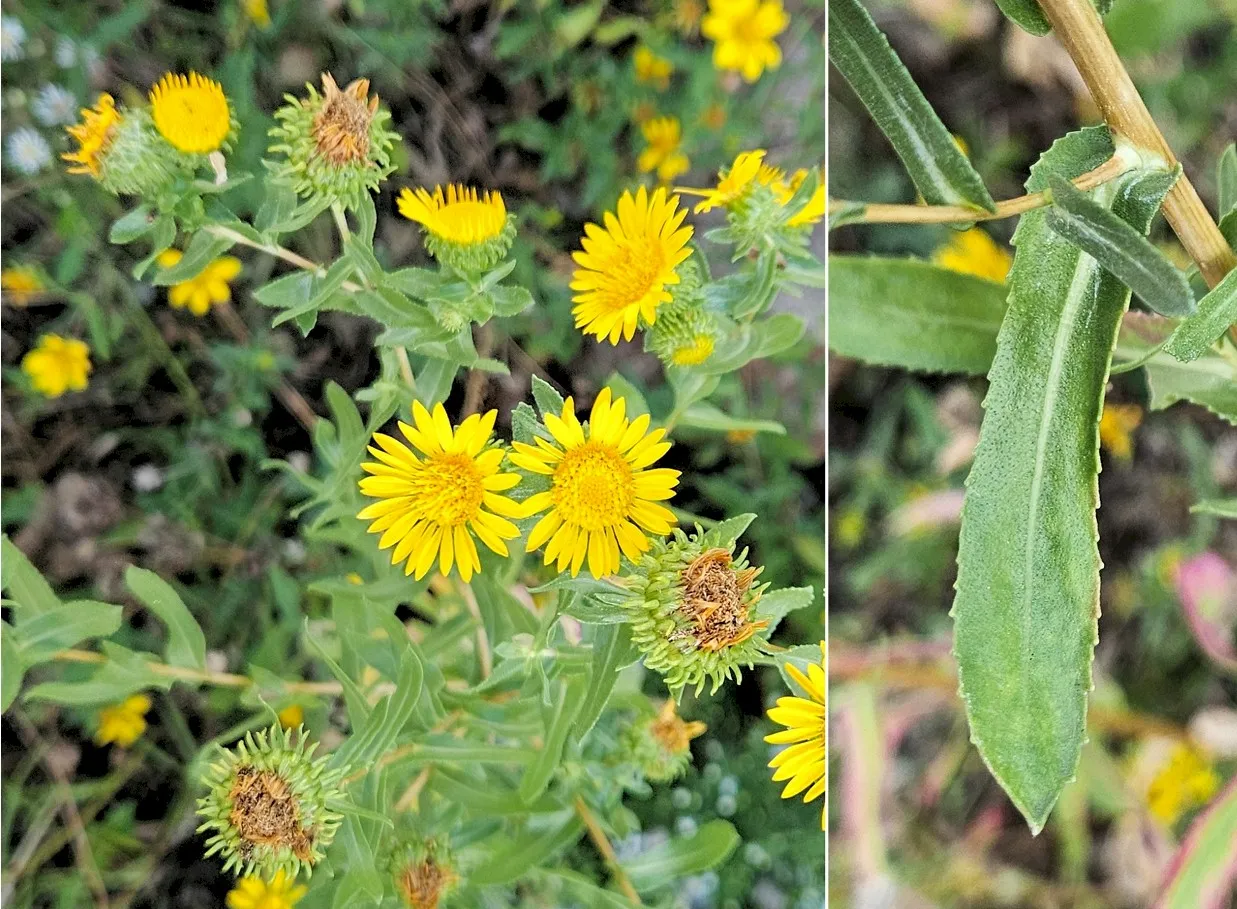
One of the easiest plants to remember in the field is blooming now. It is “Curly-Cup Gumweed” — Grindelia squarrosa (Pursh) Dunal. The common name itself serves as a built-in memory aid. "Gumweed" refers directly to the gummy, resinous substance on the plant, while "curly-cup" describes the shape of the flower heads and bracts.
Curly-cup gumweed — Grindelia squarrosa (Pursh) Dunal — is common in Golden parks and open spaces. It was adventive in my garden, meaning it found its own way there. All the collections in Jefferson County are north of Chatfield Farms but equally distributed between the plains and the foothills. The species is widespread across Colorado and is found across the United States and from northern Mexico into Canada.
The first recorded collection was made by Meriwether Lewis of the Lewis & Clark Corps of Discovery. Lewis collected the plant on August 17, 1804, in the vicinity of Tonwontonga, a large Omaha Indian village about 10 miles south of present-day Sioux City, Iowa (Earle & Reveal, 2003). Frederick Pursh (1814), working in the London herbarium of Alymer B. Lambert described our plant as Donia squarrosa. Those plant specimens still exist, having been repatriated to the United States, and images of them are available online (Lewis, 1804).
Felix Dunal (1819) of the National Museum of Natural History in Paris, France, writing about plants in the Sunflower family from the New World, recognized the similarities between our plant from the then-Louisiana Territory, and plants from Mexico and Chile, placing five species together in the genus Grindelia.
As it sometimes happens, though, there is another less well-known species of gumweed that is occasionally found in Golden. It is the “Subalpine Gumweed” — Grindelia subalpina Greene.
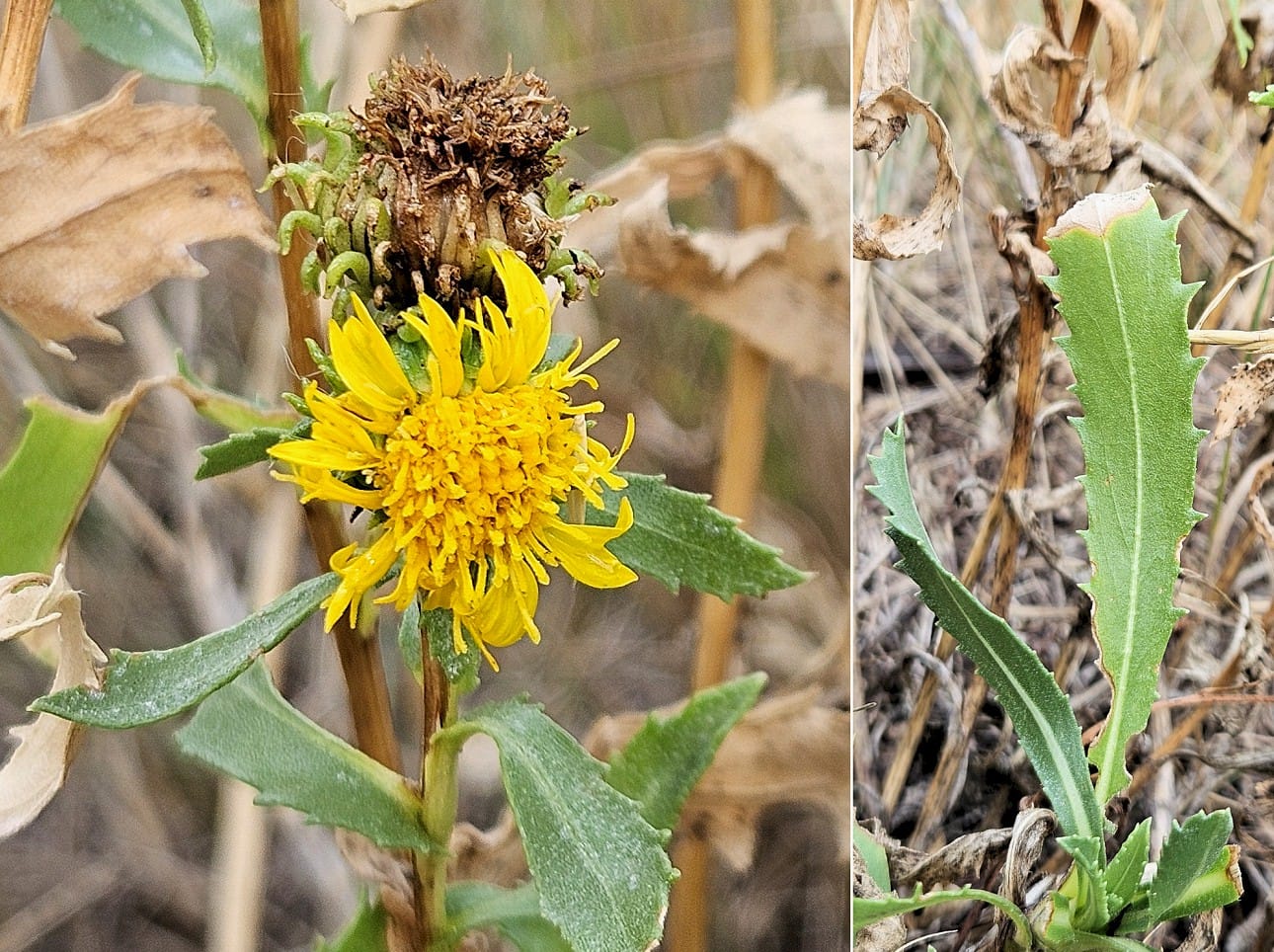
Subalpine gumweed was separated from curly-cup gumweed by Edward L. Greene (1898) for its sharply serrate leaves and other differences that we no longer recognize. Otherwise, the two species are very similar and may be confused for each other. No one will criticize you if you confuse the two species in the field.
Locally, subalpine gumweed has been found in Apex Park, Kinney Run, North and South Table Mountains, and most recently in DeLong Park. More broadly, it is found in the foothills of the Rocky Mountains from Cañon City north into southern Wyoming.
Edward L. Greene came to Colorado as an Episcopalian minister. He took an interest in plants, making the first known plant collection in Golden in 1870 (https://www.goldentoday.com/what-is-blooming-along-goldens-trails/). After years of plant study in Colorado, Greene moved to California where he became the first professor of botany at the University of California. Greene later moved east, to the Catholic University of America in Washington D.C., from where he published subalpine gumweed.
References
Dunal, Felix. 1819. Sur deux Genres de Plantes de la famille des Composees. [On two Genera of Plants of the Compositae family] Annales du Muséum d'histoire naturelle. 5: 45-58. https://www.biodiversitylibrary.org/item/108213#page/66/
Earle, A. Scott, and James L. Reveal. 2003. Lewis and Clark's Green World: The Expedition and its Plants. Helena, Montana: Farcountry Press, 2003.
Greene, Edward L. 1898. Studies in the Compositae. —VII. Pittonia. 3(18):264-305. https://www.biodiversitylibrary.org/item/52470#page/328/
Lewis, Meriwether. 1804. Coll. No. 40, Grindelia squarrosa (Pursh) Dunal. Catalog #: PH00043566. Academy of Natural Sciences of Drexel University (PH). Biodiversity occurrence data published by: SEINet - AZ/NM Node (accessed through the SEINet - AZ/NM Node Portal, https://swbiodiversity.org/seinet, 2025-09-09). https://swbiodiversity.org/seinet/collections/individual/index.php?occid=33780551
Pursh, Frederick. 1814. Flora Americae Septentrionalis; or, A Systematic Arrangement and Description of the Plants of North America. 1. London: White, Cochrane, and Co., 1814. https://www.biodiversitylibrary.org/item/197765#page/223/