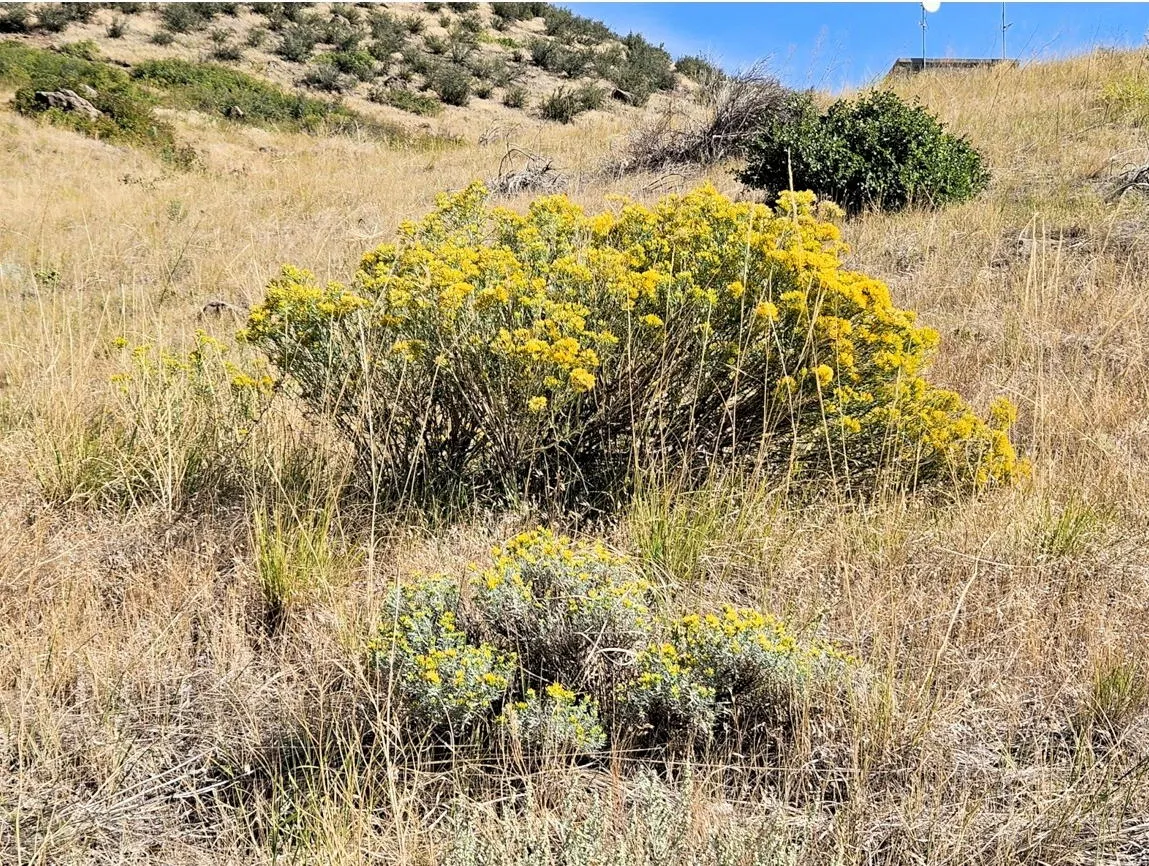
By Tom Schweich
Most of us recognize the shrubs in the photo by the common name of “Rabbitbrush,” though there is no evidence that rabbits eat, live under, or are otherwise associated with this shrub. On the other hand, it is one of the few plants that were given a common name —"Goldy-locks” — when the scientific name was published.
Thomas Nuttall (1818) published the scientific name of Chrysocoma graveolens Nutt. for our shrub based upon a collection he made on the upper Missouri River in 1811. In the same entry he published a common name of “Goldy-locks” for the genus Chrysocoma, a very logical choice because in Greek “chryso” means yellow and “coma” means tuft of hair. Over the years the genus Chrysocoma has been refined and split into other names, so that our plant is now known as Ericameria nauseosa (Pall. ex Pursh) G.L.Nesom & G.I.Baird. However, the fact remains that its first published common name was Goldy-locks, and “Rabbitbrush” is a recent invention.
As it happens, we have two varieties of Ericameria nauseosa in Golden. They can be seen growing and blooming together on the Shoshonite Trail of South Table Mountain.
The large showy shrub with bright yellow flowers is the plant that was described by Thomas Nuttall (1818) when he used the common name Goldy-locks. Today we call it Ericameria nauseosa variety graveolens. This is very common in all of Golden’s open spaces, parks, and gardens.
We also have a smaller variety (in the foreground of the photo above) that is variety nauseosa. Variety nauseosa can be easily distinguished from variety graveolens by its smaller size, somewhat more blue-ish appearance, and more narrow and short leaves. This is sometimes called “Dwarf Rabbitbrush” but it is not a dwarf. It is naturally small.
When I first wrote about variety nauseosa I thought it was uncommon in Golden because, at the time, it was known only from the lower slopes of South Table Mountain, and along Highway 6 at Eagle Ridge (between Kinney Run and Centura Urgent Care). However, revisiting Golden’s open spaces while working on the Open Space Working Group, I have since found our plant in Grampsas North, North Table Mountain, and Parfet Open Spaces. So, it is probably more common than previously thought.
References:
Nuttall, Thomas. 1818. The Genera of North American Plants and a catalogue of the species to the year 1817. 2 Vols.. Philadelphia: 1818. Link to Goldy-Locks.