By Tom Schweich
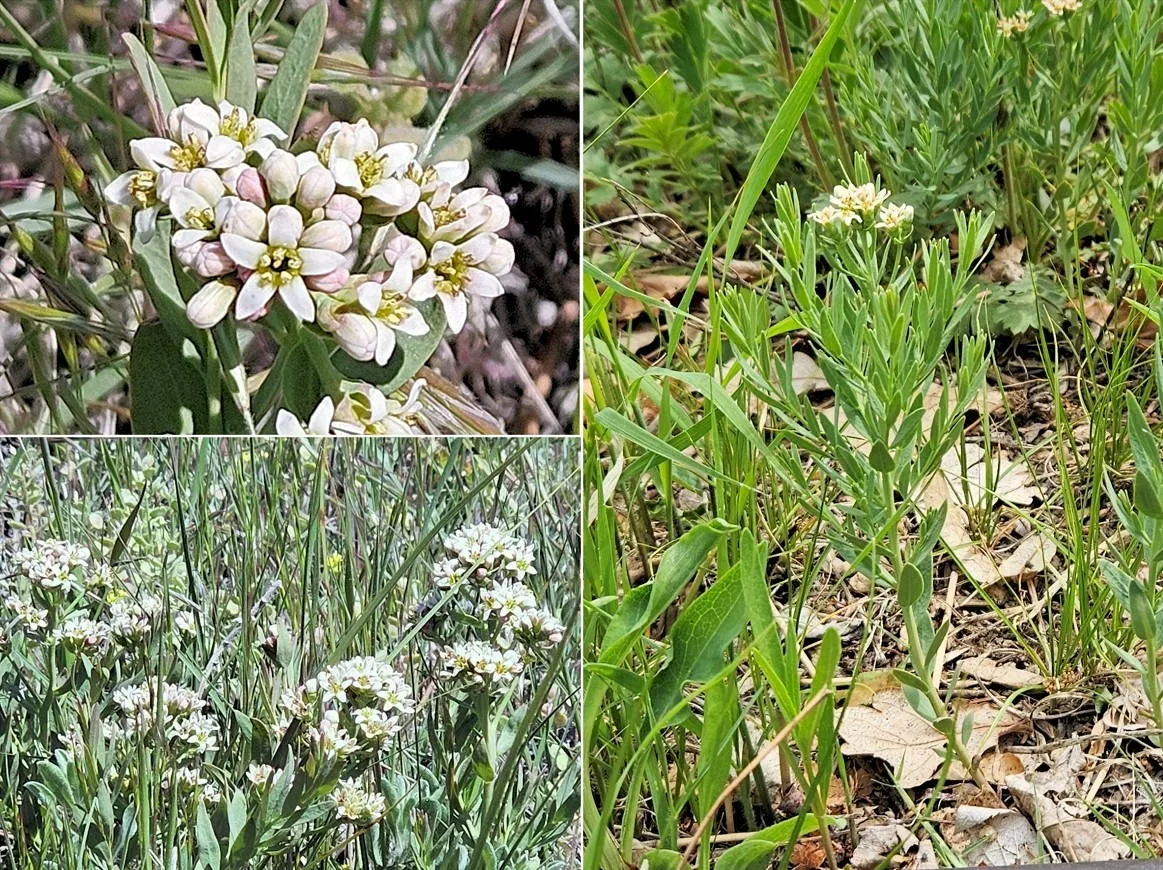
Pale Bastard Toadflax — Comandra umbellata (L.) Nutt. ssp. pallida (A. DC.) Piehl — is common in all Golden open spaces and some parks, though it is often overlooked because it is small and the flowers are not showy. The plant is found across the United States and into Canada, while the subspecies found in Colorado, subspecies pallida, is found between Kansas/Nebraska west to Nevada. Bastard toadflax has an unusual global distribution. There is one species in North America with three subspecies, and a fourth subspecies in the Balkan region of Europe.
The name "bastard toadflax" for Comandra umbellata originates from the similarity between the plant's leaves and those of true toadflax (genus Linaria). However, the name is not meant to be a derogatory one, but rather a description of a plant that is not a true toadflax but resembles it. Indeed, the Weedbusters (City of Golden, 2025) struggle to distinguish between toadflax and bastard toadflax while weeding at DeLong Park. Often, we must wait until the plants get larger to distinguish between the two.
Thomas Nuttall (1818) first published the name Comandra umbellata, using a Linnaeus name of Thesium umbellatum as a base-name. Unfortunately, Nuttall did not tell us if he saw it along the Missouri River in 1811. C. pallida was proposed by A. DeCandolle (1857) from a collection made in Oregon Territory (present-day Nez Perce County, Idaho) by missionary Reverend Henry H. Spalding.
Reverend Spalding collected plants for one year in 1846 and sent a box of dried plants to botanists in the east (Oliphant, 1934; Wikipedia, 2025). He apparently got the idea from Charles A. Geyer, a German botanist, who was in Oregon Territory in 1843-44. Spalding’s box of plants arrived in Boston in 1848. Asa Gray sent Spalding a letter encouraging him to continue collecting in March 1849. However, a massacre at Waiilatpu (now in Walla Walla County, Washington) sent Spalding and others fleeing to Lower Oregon, ending his botanical career.
Pale bastard toadflax has some interesting characteristics. First, it parasitizes other plants from its rhizomes as do many plants of its family, the Sandalwood family (Santalaceae, san-ta-LA-see-e). However, because it can photosynthesize with green leaves and stems, we call it a hemi-, or half-, parasite. Bastard toadflax plays a role in forest pathology as alternate hosts of the comandra-pine blister rust. Finally, our subspecies, pallida, dies back to the ground each year, resprouting each spring from subterranean buds, whereas the other subspecies retain above-ground parts through the winter.
References
City of Golden. 2025. DeLong Park Weedbusters Volunteers. https://www.cityofgolden.gov/community/get_involved/delong_park_weedbusters.php
DeCandolle, Augustus Pyramus. 1857. Prodromus Systematis Naturalis Regni Vegetabilis. [Overview of the Natural System of the Plant Kingdom.] 14. Paris: 1857. https://www.biodiversitylibrary.org/item/109211#page/642/
Nuttall, Thomas. 1818. The Genera of North American Plants and a catalogue of the species to the year 1817. 2 Vols.. Philadelphia: 1818. https://www.biodiversitylibrary.org/page/722357#page/164/
Oliphant, J. Olin. 1934. The Botanical Labors of the Reverend Henry H. Spalding. The Washington History Quarterly. 25(2):93-102. https://journals.lib.washington.edu/index.php/WHQ/article/viewFile/8781/7816
Wikipedia contributors. (2025, May 7). Henry H. Spalding. In Wikipedia, The Free Encyclopedia. Retrieved 02:49, May 24, 2025, from https://en.wikipedia.org/w/index.php?title=Henry_H._Spalding&oldid=1289240893