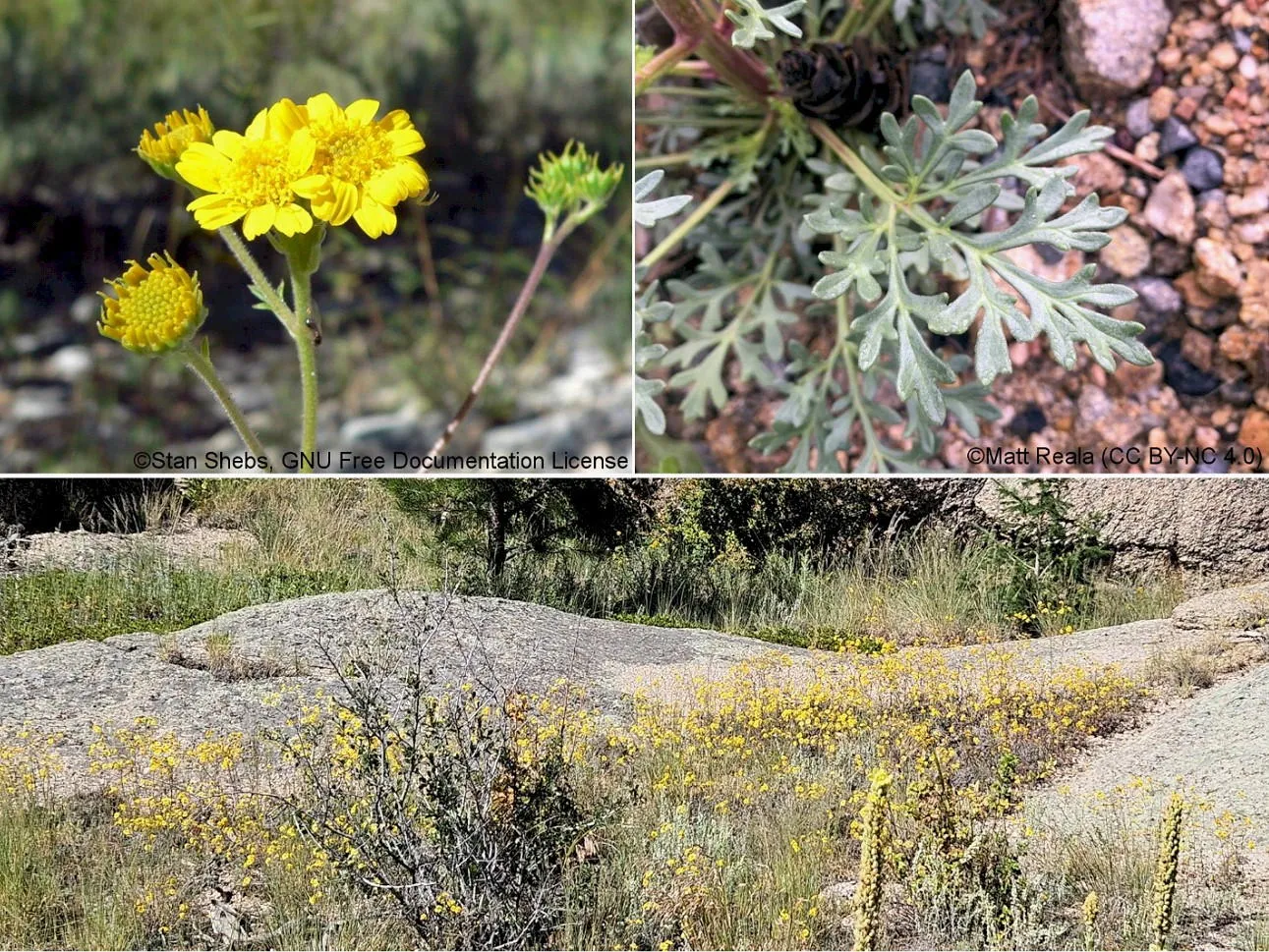
Jefferson County is somewhat long and narrow from north to south, and in its southern reaches becomes confined between the South Fork of the South Platte River and the high ridge of the Tarryall Mountains. One road crosses this area, the Pike-San Isabel Forest Road 211, sometimes also known as Matukat Road or Goose Creek Road. At roughly 8,000 feet elevation, the plants are more like the flora of Golden (roughly 6,000 feet) than the subalpine plants near Leadville at roughly 10,000 feet elevation.
Exploring the plants along Forest Road 211 road recently, I repeatedly came across Hymenothrix dissecta (A. Gray) B. G. Baldwin. Its numerous common names include “cutleaf,” “ragleaf bahia,” “ragged-leaf bahia,” and “yellow ragweed.” I use the common name of “cutleaf” that is published in our current Flora of Colorado (Ackerfield, 2022). You may also see it referred to by a different scientific name, Bahia dissecta (A. Gray) Britton, which was a previously accepted scientific name for the plant.
While digging through the online database records, I found that our plant was found one time in Golden. In 1981, Ronald & Judy Wittmann collected our plant where US Highway 6 crosses Clear Creek. Ronald Wittmann is an author of Colorado Flora: Eastern Slope (Weber & Wittmann, 2012). I have looked for our plant along Clear Creek several times but have not found it. Of course, there has been highway and other construction at that location since 1981, and it is entirely possible that our plant has been extirpated from Golden.
American botanist Asa Gray (1849) described our plant as Amauria? dissecta from fragmentary material collected by Agustus Fendler east of the Mora River, New Mexico. The Mora River crosses under US Interstate 25 at Watrous, New Mexico, between Las Vegas and Raton. Gray also had other fragmentary material collected by John C. Fremont on one of his expeditions through Colorado. The fragmentary plant parts left Gray with no choice but to take a guess, adding a question mark to his name Amauria?.
In the same publication, Gray (1849) published the generic name Hymenothrix for a different plant collected by Dr. Wislizenus at Ojo de Gallejo, between El Paso, Texas, and Chihuahua, Mexico. Hymenothrix comes from two Greek words: hymen (ὑμήν), meaning "membrane," and thrix (θρίξ), meaning "hair" or "bristle". This name refers to bristle-like structures in the flower head. Our plant bounced around between several genus names, such as Amauria?, Bahia, Villanova, and Amauriopsis, until recent analysis of genetic data showed it was most closely related to Hymenothrix (Baldwin & Wood, 2016).
The species name, usually called the “specific epithet,” of dissecta comes from the Latin word "dissectus" meaning "cut into pieces." This aptly describes the plant's leaves, which are finely divided or dissected into narrow segments.
Cutleaf is native to the western United States as far north as the Black Hills of South Dakota and Wyoming, south into northern Mexico, and from Texas west to California.
Like blue grama grass that we discussed last week, the oldest collection of cutleaf from Colorado was made by Charles C. Parry in 1861, somewhere between the headwaters of Clear Creek and Middle Park.
References
Ackerfield, Jennifer. 2022. Flora of Colorado, Second Edition. Botanical Miscellany No. 60. Fort Worth, Texas: BRIT Press, Fort Worth Botanical Garden, 2022.
Baldwin, Bruce G., and Kenneth R. Wood. 2016. Origin of the Rapa endemic Apostates: Revisiting major disjunctions and evolutionary conservatism in the Bahia alliance (Compositae: Bahieae). Taxon. 66(5):1064-1080. https://www.researchgate.net/publication/309708655_Origin_of_the_Rapa_endemic_genus_Apostates_Revisiting_major_disjunctions_and_evolutionary_conservatism_in_the_Bahia_alliance_Compositae_Bahieae/
Gray, Asa. 1849. Plantae Fendlerianae Novi-Mexicanae [Fendler’s New Mexican Plants]; An Account of a Collection of Plants made chiefly in the Vicinity of Santa Fe, New Mexico, by Augustus Fendler; with Descriptions of the New Species, Critical Remarks, and Characters of other undescribed or little-known Plants from surrounding Regions. Memoirs of the American Academy. IV(I):1-116. https://www.biodiversitylibrary.org/item/55373
Weber, William A., and Ronald C. Wittmann. 2012. Colorado Flora: Eastern Slope. 4th Edition. Boulder, Colorado: University Press of Colorado, 2012.
Wittmann, Ronald C. and Judy Wittmann. 1981. Collection No. 1881, Bahia dissecta (A. Gray) Britt. [=Hymenothrix dissecta (A. Gray) B. G. Baldwin]. Biodiversity occurrence data published by: SEINet - AZ/NM Node (accessed through https://swbiodiversity.org/seinet, 2025-08-21). COLO00049536 RM358663