By Tom Schweich
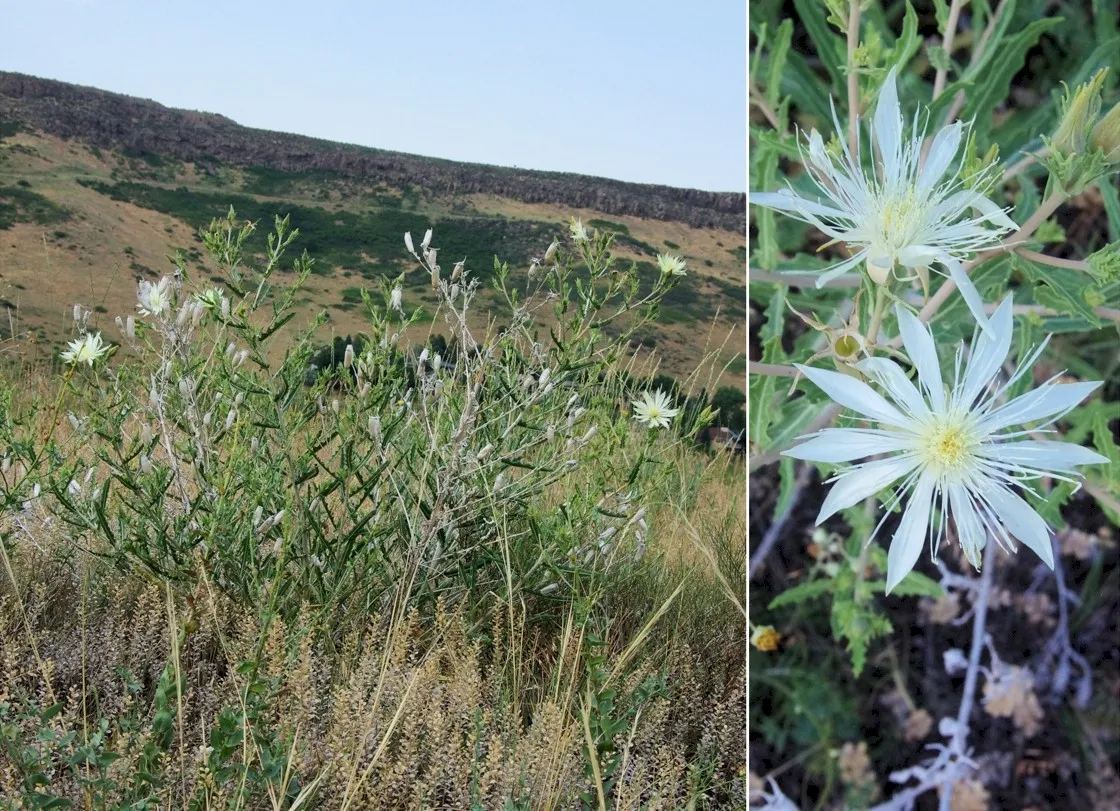
Bractless blazingstar – Mentzelia nuda (Pursh) Torr. & A. Gray – is starting to bloom now in some of our open spaces. Look for it along trails that cross dry gravelly ridges and slopes in the late afternoon and early evening.
Bractless blazingstar is a short-lived perennial whose blooming is described as "vespertine," meaning that the flowers typically open around dusk or in the early evening. This timing is often an evolutionary adaptation to attract pollinators that are active during the evening or night, such as moths and bats. Many vespertine flowers are white or light-colored to be more easily seen by nocturnal pollinators in low light conditions.
The flowers of bractless blazingstar continue to secrete nectar long after the petals and stamens have withered and fallen off (Helzer, 2016). This attracts ants whose presence significantly improves seed production by warding off insects that might eat the developing seeds.
Two botanists we met before, Frederick Pursh and Thomas Nuttall, tangled in a public feud over who should get credit for discovering our plant. To set the stage, Pursh would have seen a single seed pod collected by Lewis & Clark while returning from the Pacific coast in 1806. But that was not enough material to describe a new plant. Nuttall, though, brought seeds back to England from his travels on the Missouri River in 1811. Live plants were grown from Nuttall’s seeds in the gardens of A. B. Lambert in southwest England and John Fraser in London. Nuttall thought he and Pursh had agreed to share authorship of the new species. But Pursh (1814), seeing those garden-grown plants, described them in his Flora of North America. Nuttall (1818) was quite unhappy with Pursh, complaining in print of Pursh’s “… unfortunate want of fidelity …”
References
Helzer, Chris. 2016. The Curious Case of Stickleaf Flowers – Yet Another Fascinating Natural History Story. The Prairie Ecologist. https://prairieecologist.com/tag/mentzelia-nuda/
Nuttall, Thomas. 1818. The Genera of North American Plants and a catalogue of the species to the year 1817. 2 Vols. Philadelphia: 1818. https://www.biodiversitylibrary.org/item/7244#page/305/
Pursh, Frederick. 1814. Flora Americae Septentrionalis; or, A Systematic Arrangement and Description of the Plants of North America. 1. London: White, Cochrane, and Co., 1814. https://www.biodiversitylibrary.org/item/1987#page/379/ and https://www.biodiversitylibrary.org/item/197765#page/413/