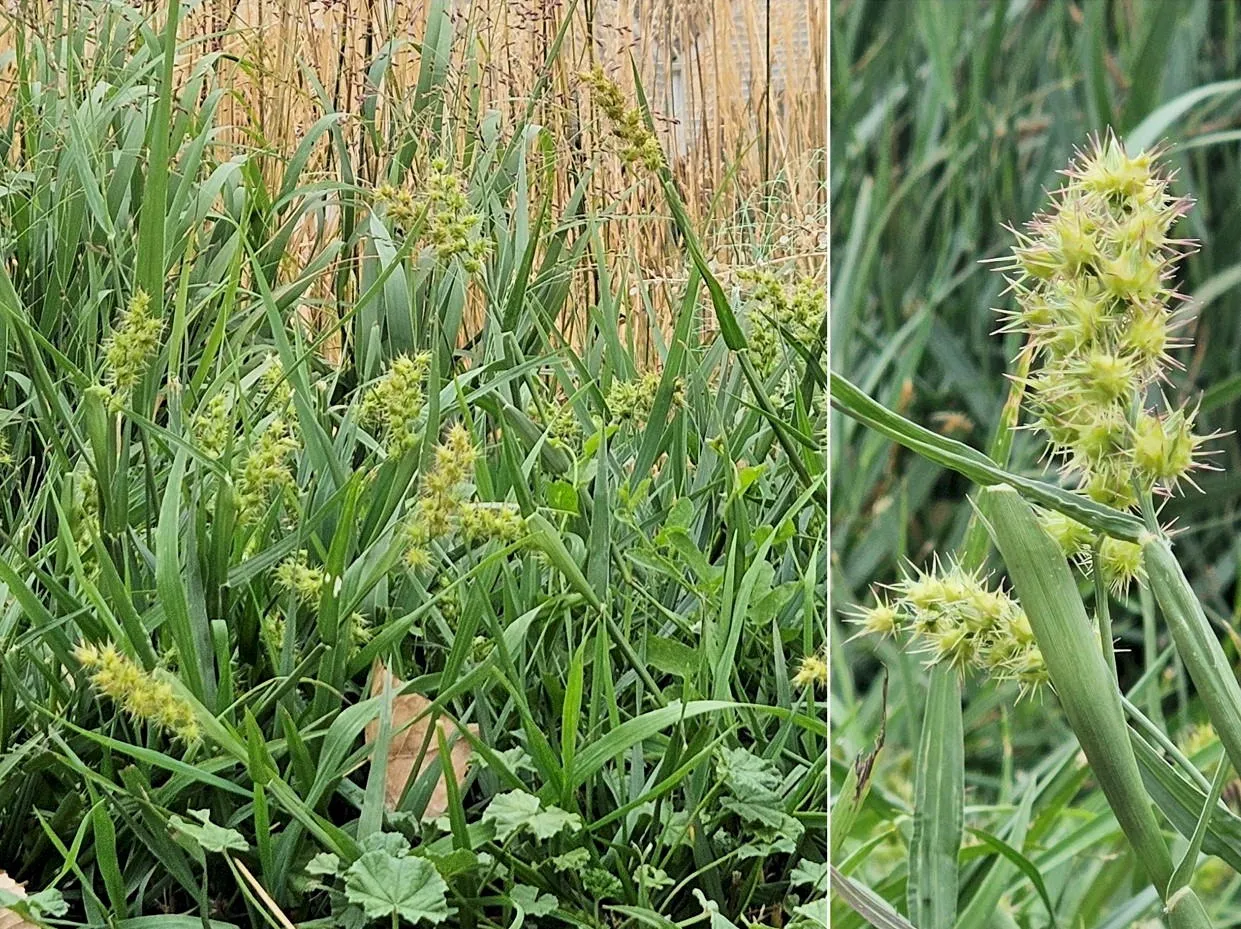
While we like to have native Colorado plants in our gardens and parks, there are a few natives that we would rather not have.
Chief among them in Western Poison Ivy — Toxicodendron rydbergii (Small ex Rydb.) Greene — usually found in semi-shaded and damp places like along the irrigation ditches. Most of us recognize western poison ivy from our Scouting days, “leaves of three, let it be.”
There is another native plant – a grass actually – that we really don’t want in our gardens and parks. It is “Longspine Sandbur” — Cenchrus longispinus (Hack.) Fern. — a weedy grass best known for its sharp, spiny seed heads that cling painfully to shoes, clothing, and animal fur. The plant grows in dry, disturbed places such as roadsides, trails, and fields, often forming low, spreading patches. Its burs are small but very spiky, making it unpleasant for people, pets, and wildlife to encounter them. Though it’s a native grass in Colorado and other parts of North America, it behaves like a nuisance weed where it spreads aggressively, reducing the enjoyment of open space areas.
Longspine sandbur was first described in Merritt Fernald’s (1943) paper “Virginian Botanizing Under Restrictions,” a half botany, half wry social commentary that described the odd experience of trying to do fieldwork when civilian life was tightly regulated during World War II. Fernald notes how gasoline rationing, travel restrictions, and even rules about what food or supplies could be carried all shaped his botanical trips. Field botanists had to plan carefully, making short excursions close to home rather than the wide-ranging surveys they might have done in peacetime. He jokes about dodging regulations, improvising meals, and relying on the kindness of local residents—while still managing to discover and describe plants, including the prickly longspine sandbur.
Colorado collections of longspine sandbur are mostly out on the plains, though there are many collections in the urban areas. The burs probably hitched a ride from the open fields on clothing or animal fur.
The first collection in Colorado was by Edward L. Greene on September 20, 1872, in Greeley, Weld County, followed closely by T. S. Brandegee, in September 1873, at Cañon City, Fremont County. There are nine other 19th century collections that are scattered up and down the high plains near the Front Range.
The first Jefferson County collection was in 1954 on cultivated land near 48th Street and Wadsworth at a time when much of Wheat Ridge was agricultural in character.
In Golden, longspine sandbur has been found in DeLong Park, and most recently in New Loveland Mine Park. There is also report of the grass on South Table Mountain.
At DeLong Park, the Weedbusters group of volunteers found longspine sandbur in 2022 and are weeding it by hand. It can be hard to see, but easy to find by just putting your hand down on the ground. You can feel the bur right through your glove!
At New Loveland Mine Park, our Parks & Recreation Department has a plan to deal with the grass that focuses on the fact that it is an annual grass, so if the seeds can be eliminated, or prevented from germinating, the plants can be eliminated.
References
Fernald, M. L. 1943. Virginian Botanizing Under Restrictions. Rhodora; Journal of the New England Botanical Club. 45(538):357-412. https://www.biodiversitylibrary.org/page/609801#page/404/