By Tom Schweich
A third tree we would rather not have in Golden is the Siberian elm — Ulmus pumila L. It is called the Siberian elm because Linnaeus wrote in the first modern flora, Species Plantarum, that the tree grew in Siberia. Today, we know the native range of Siberian elm extends from Kazakhstan through southern Siberia to Korea.
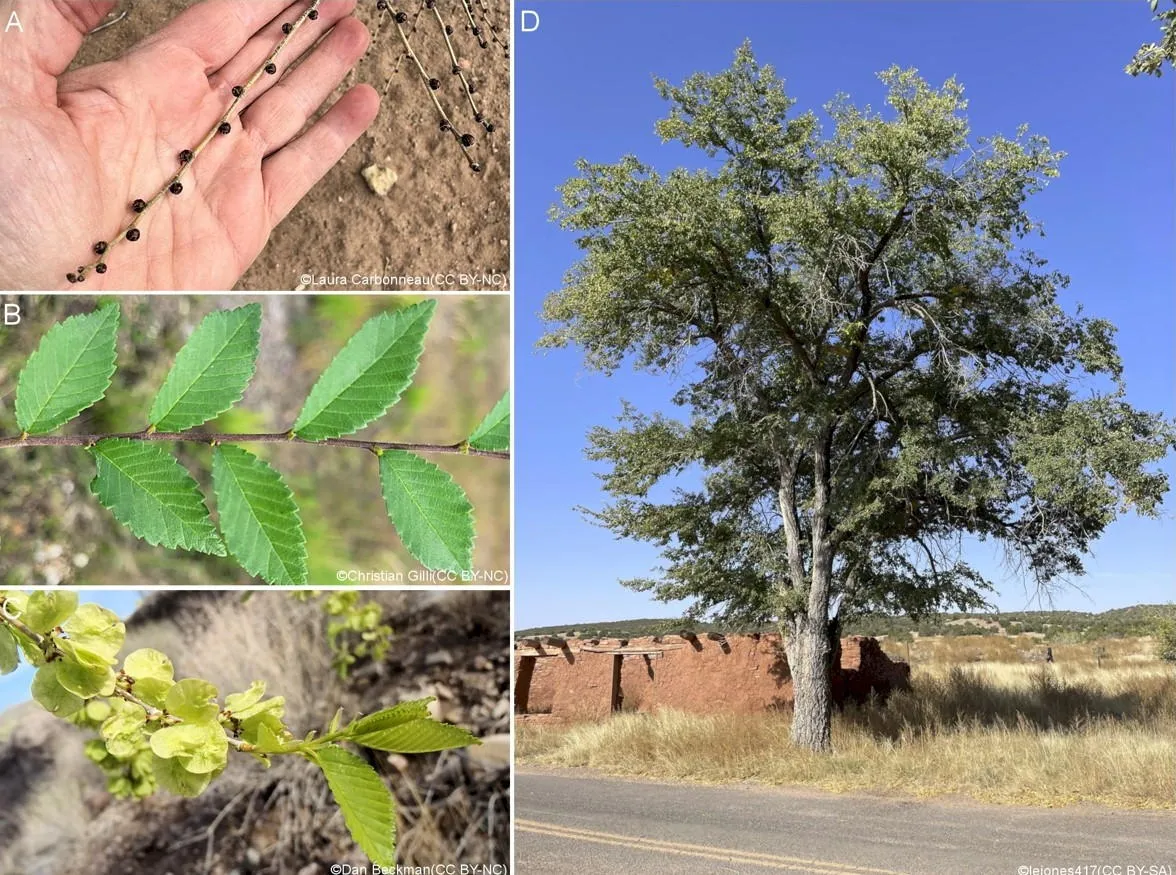
Siberian elm is easy to recognize, even in winter because the buds look like little balls closely spaced along the smaller branches (Figure 1A). The mature leaves are small with a serrate margin (a single row of saw-like teeth, Figure 1B). The fruit is a samara, like maple trees, except that the wing surrounds the seed (Figure 1C). The wing makes it easy for the seeds to fly around the neighborhood in the wind and explains why there are Siberian elm seedlings in our gardens every spring. The tree has an irregularly furrowed gray bark, and the limbs often grow at odd angles (Figure 1D).
Siberian elm was first introduced to North America in the 1860s as an ornamental tree valued for hardiness, rapid growth, and tolerance of cold and drought. It appeared in 19th-century U. S. Nursery catalogs, so wide distribution began quite early. The oldest record of Siberian elm in Colorado is from Colorado Agricultural College, now Colorado State University – Fort Collins, in 1923. The tree was thought to be about 10 years old at the time (Longyear, 1923).
After the Dust Bowl era of the 1930s, the USDA encouraged Siberian elm in shelterbelts and windbreak plantings across the Great Plains because it was thought to protect soil and livestock from harsh winds and drought (Klingaman, 1999). Through the mid-20th century, it was sold commercially as a shade and hedge tree and widely planted in towns and cities for quick cover and ornamental purposes.
Siberian elm is now considered invasive in many parts of the United States; it escapes cultivation and spreads into prairies, riparian areas, grasslands, and disturbed sites in at least 25 states (USDA, 2025). Dense colonies of seedlings can displace native vegetation, reduce biodiversity, and alter community structure. The tree can resprout from stumps and roots, making it difficult to eradicate once it is established. Urban and roadside plantings have been criticized because Siberian elms have brittle wood and poor form, producing weak branches that break easily, especially in windstorms.
I had thought that Siberian elm was poorly adapted to the dry conditions of our Colorado climate. It turns out that it is not true; the tree will thrive in very dry climates though in times of extreme stress major branches or even the crown will die back to the trunk.
The Colorado Department of Agriculture has declared Siberian elm a List C Noxious Weed because it is widespread, well-established, and highly invasive, yet not mandated for state-level eradication. Instead, the state provides resources for voluntary management, while local governments may require control. City staff are currently working on Golden’s first Local Noxious Weed Management Plan.
There are no elms that are native to Colorado. However, the American elm (Ulmus americana L.) is native to adjacent states of Kansas, Nebraska, and Wyoming (POWO, 2026). The earliest record in Colorado was also found on the campus of Colorado Agricultural College (Cowen, 1893). Linnaeus (1753) knew of American elm from records made in Virginia.
I have received a few nominations for other trees we would rather not have in Golden, such as Callery pear (Pyrus calleryana Decne.), though I think it might be time to write about native trees we would like to have, just to balance things out.
References
Cowen, J. 1893. Ulmus americana L. CS154003. Date: 1893-06-19. Locality: United States, Colorado, Larimer County, College grounds. Biodiversity occurrence data published by: SEINet - AZ/NM Node. https://swbiodiversity.org/seinet/collections/individual/index.php?occid=515014
Klingaman, G. (1999). Plant of the Week: Siberian Elm. Extension News, University of Arkansas, Division of Agriculture. https://www.uaex.uada.edu/yard-garden/resource-library/plant-week/siberian-elm.aspx
Linne´, Carl von. 1753. Species Plantarum. https://www.biodiversitylibrary.org/page/358245#page/238/
Longyear, B. O. 1923. Ulmus pumila L. CS190072. Date: 1923-04-27 Locality: United States, Colorado, Larimer County, C.A.C. Arboretum. Biodiversity occurrence data published by: SEINet - AZ/NM Node. https://swbiodiversity.org/seinet/collections/individual/index.php?occid=27215750
POWO, 2026. Ulmus americana L. Plants of the World Online. Facilitated by the Royal Botanic Gardens, Kew. https://powo.science.kew.org/taxon/urn:lsid:ipni.org:names:304464-2
USDA. 2025. Siberian elm. Weed of the Week. https://www.invasive.org/weedcd/pdfs/wow/siberian-elm.pdf