
I made a mistake yesterday in posting Tom Schweich's article about Douglas firs--I printed the first few paragraphs twice and left off the second half. (Sorry Tom!) Here it is in full.
By Tom Schweich
Recently I wrote about Creeping barberry – Berberis repens Pursh – as a local native plant that retains its leaves through the winter season. In that article I also mentioned two Englishmen, David Douglas and Archibald Menzies, who traveled extensively in the Pacific Northwest and became associated with a local native cone-bearing tree: the Douglas-fir – Pseudotsuga menziesii (Mirb.) Franco.
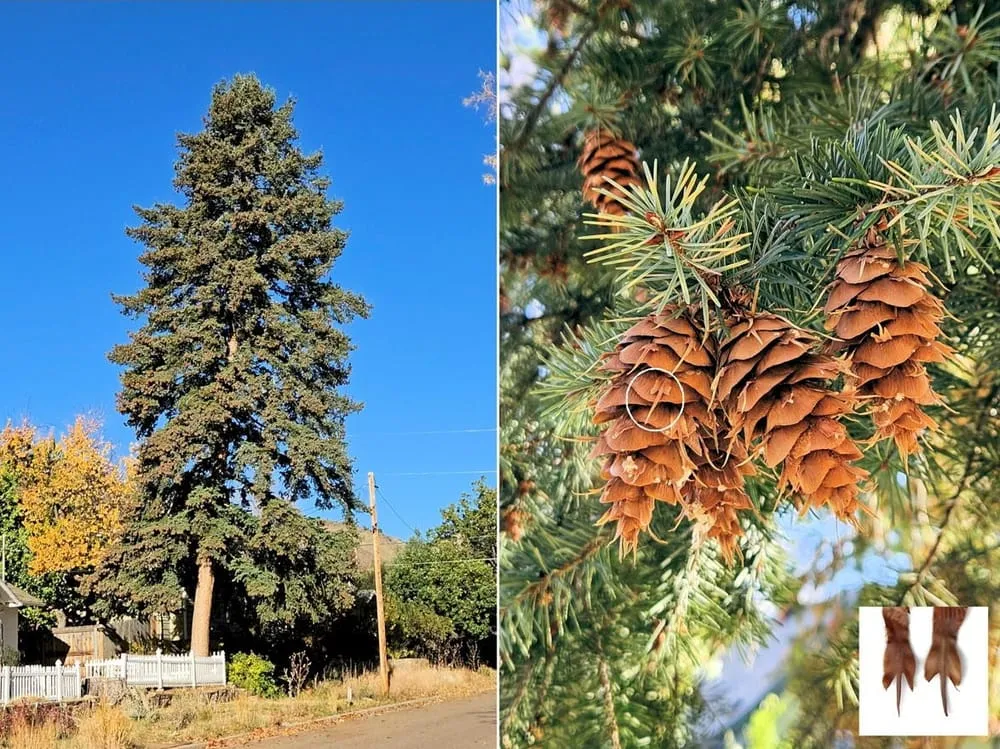
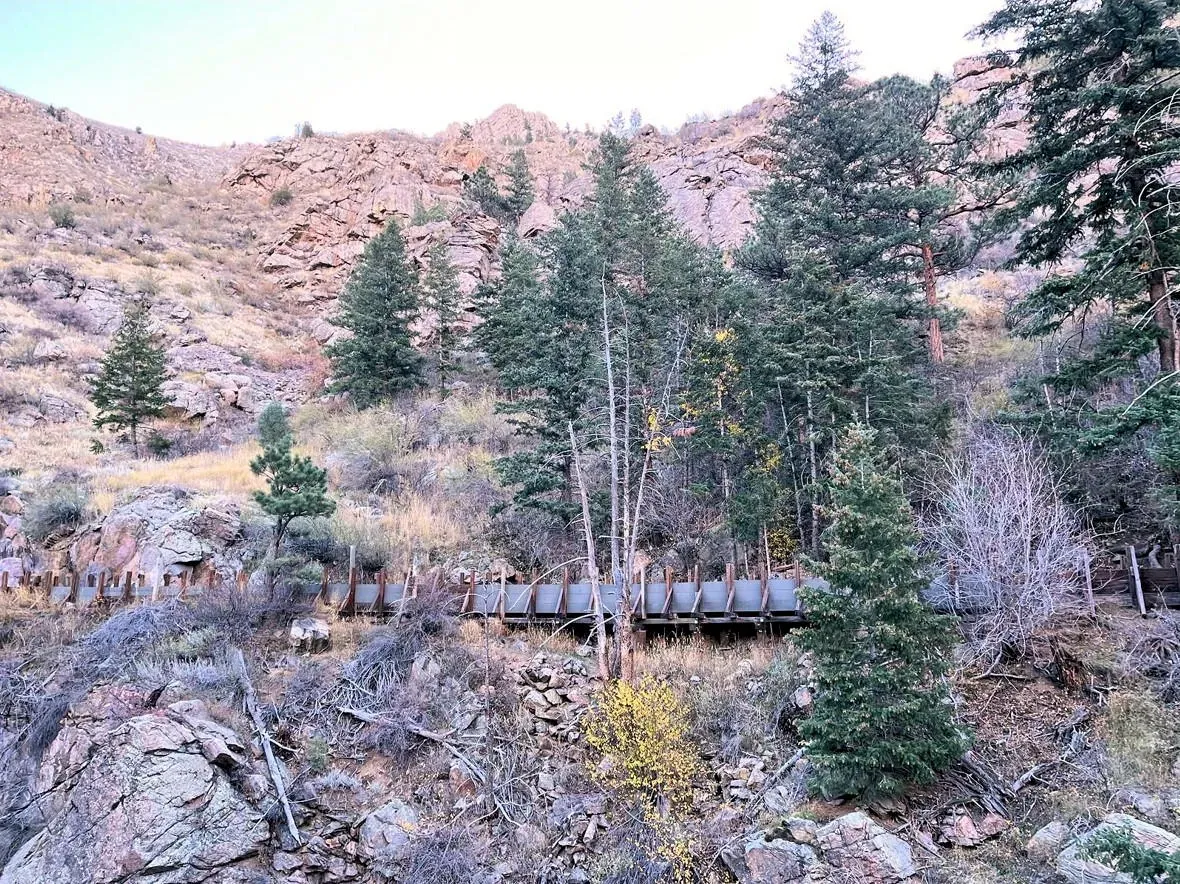
Like many of Colorado’s native cone-bearing trees, Douglas-fir retains most of its leaves through the winter while shedding a few old leaves year-round. Douglas-fir is not natively found within the Golden city limits because our climate is too hot and dry. However, along the Peaks to Plains Trail, e.g., at the suspension bridge crossing to Welch Ditch, the north-facing slopes of the canyon provide habitat and a place to see this majestic tree.
Douglas-fir trees are easy to recognize in the field. Besides being a majestic tree, the cones hang downward and have a unique three-pointed bract (see the photo above). Also, the leaves (needles) are arranged around the stem in a spiral and have blunt tips.
While botanist Archibald Menzies first documented the tree in North America (1792), Pseudotsuga menziesii is commonly called Douglas-fir because the Scottish botanist David Douglas introduced the tree to cultivation in Europe in 1827 by sending seeds back to England.
Douglas-fir was given many different scientific names as European botanists worked to determine its place in the classification of plants. During this time our tree was sometimes named for Douglas and sometimes named for Menzies. Douglas-fir was first placed in the pines (Pinus) by Lambert (1803), then the firs (Abies), and then hemlocks (Tsuga). Finally, Carriere (1867), recognizing that Douglas-fir was intermediate between the firs and hemlocks, proposed Pseudotsuga (false hemlock) for it and three other species of trees world-wide.
Douglas-fir is widely distributed from the Rocky Mountains of Colorado to the Pacific coast of California, Oregon and Washington, and from British Columbia south to the mountains of Mexico. We typically say there is a Rocky Mountain variety of Douglas-fir here in Colorado. It is called variety glauca, because the leaves of our Colorado trees have a waxy coating giving them a bluish appearance. However, in the Pacific Northwest, trees with and without the waxy coating grow together and intergrade, so that (maybe) our variety of glauca is a distinction without a real difference.
Douglas-fir has high economic value due to its importance for construction lumber. While it can be more expensive than other options like spruce, Douglas-fir often outperforms spruce in strength and density metrics.
Douglas-fir will thrive in Golden proper even though it is not native. They just need to be watered in both summer and winter(!).
References
Carriere, Elie-Abel. 1867. Traité général des conifères; ou, Description de toutes les espèces et variétés de ce genre aujourd'hui connues, avec leur synonymie, l'indication des procédés de culture et de multiplication qu'il convient de leur appliquer. [General treatise on conifers; or, Description of all the species and varieties of this genus known today, with their synonymy, an indication of the cultivation and multiplication methods which should be applied to them]. Paris: Chez l'Auteur, [House of the author.] 1867. Page 256, described as Pseudotsuga douglasii. https://www.biodiversitylibrary.org/item/106503/#page/272/
Lambert, Aylmer Bourke, Esq., F.R.S, F.S.A. 1802. A description of the genus Pinus: illustrated with figures, directions relative to the cultivation, and remarks on the uses of the several species. Tab 33, page 51, described as Pinus taxifolia. https://www.biodiversitylibrary.org/item/98773/#page/123/
Wikipedia contributors, "Archibald Menzies," Wikipedia, The Free Encyclopedia, https://en.wikipedia.org/w/index.php?title=Archibald_Menzies&oldid=1295970263 (accessed October 17, 2025).
Wikipedia contributors, "David Douglas (botanist)," Wikipedia, The Free Encyclopedia, https://en.wikipedia.org/w/index.php?title=David_Douglas_(botanist)&oldid=1307755851 (accessed October 17, 2025).

%20Franco.)