

By Tom Schweich
Previous articles have discussed the plants that are in bloom along Golden’s trails. With winter approaching, our flowering plants are hunkering down, waiting until next spring’s warmth. We have a few plants that retain their leaves through the winter, most notably the cone-bearing trees, such as pines, firs, and spruces. We also have a few native shrubs or sub-shrubs that retain their leaves in winter. One attractive winter native plant is “Creeping Barberry” — Berberis repens Lindley.
Creeping barberry has shiny green leaves on creeping stems and bright yellow flowers in spring. In the fall, there are purple berries among leaves that turn bright red. I would not walk on it in my bare feet, though, because the leaves have sharp teeth. Not quite as sharp as the real holly — Ilex aquilifolium L. — which is in a whole different family, but sharp enough to get your attention. The origin of the generic name Berberis is thought to be an Arabic name for the fruit. The etymology of "repens" in Berberis repens comes from the Latin word for "creeping," which describes the plant's growth habit of spreading along the ground by stolons.
Creeping barberry has been collected or observed in every Golden Open Space, typically around the edges of Golden, on slopes of the mesas, among rocks, or the lower canyons of Apex, Windy Saddle, and Mount Galbraith Parks to the west. There are not many collections in Jefferson County, and those are mainly right along the Front Range, but I suspect it is far more common than the number of collections would imply.
The story of how our plant was discovered and described starts once again with Meriwether Lewis’ & William Clark’s Corps of Discovery and ends (once again!) in the horticultural gardens of London, England. Lewis & Clark traveled across the North American continent by way of the Missouri and Columbia Rivers in 1804-5, returning to the United States in 1806. One of the plants they brought back was Oregon grape — Berberis aquifolium Pursh — a large evergreen shrub that does not occur in Colorado. You may also know it as Mahonia aquilifolium (Pursh) Nutt.
Lewis & Clark also brought back some seeds from a plant that was similar, but much smaller. These seeds were grown in gardens of the eastern U.S., in particular the garden of Mr. Michael Floy, Nurseryman at New York. Even though the plants were small, they were sold under the name of Berberis aquifolium Pursh, i.e., Oregon grape.
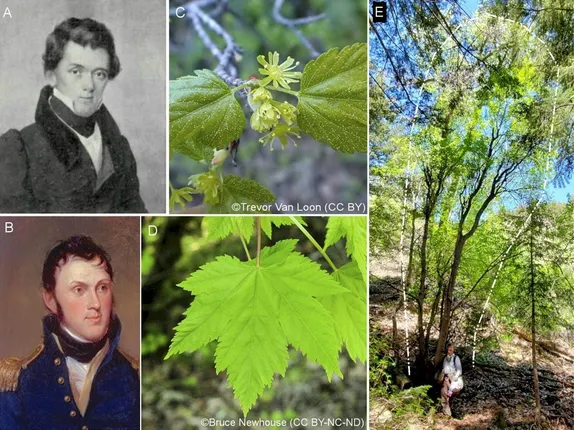
Buyers from the Horticultural Society (England) purchased one of Mr. Floy’s plants for twenty-five dollars, about $820 at today’s prices. It was taken back to England and grown in one of the Horticultural Society’s several gardens around London, England. John Lindley, secretary to the Horticultural Society, was familiar with similar plants described by David Douglas and Archibald Menzies, two Englishmen who traveled extensively in the Pacific Northwest. Lindley (1828) recognized our plant as a different species than Oregon grape and gave it the name of Berberis repens Lindley.
Creeping barberry — Berberis repens Lindley — is often available in nurseries and relatively easy to grow in the garden, though a little shade or a little water might help it thrive at our lower elevations.
References
Lindley, John. 1828. Berberis repens. Botanical Register. Vol. 14, No. 1176. https://www.biodiversitylibrary.org/item/9050#page/138
Wikipedia contributors, "Archibald Menzies," Wikipedia, The Free Encyclopedia, https://en.wikipedia.org/w/index.php?title=Archibald_Menzies&oldid=1295970263 (accessed October 17, 2025).
Wikipedia contributors, "David Douglas (botanist)," Wikipedia, The Free Encyclopedia, https://en.wikipedia.org/w/index.php?title=David_Douglas_(botanist)&oldid=1307755851 (accessed October 17, 2025).
Wikipedia contributors, "John Lindley," Wikipedia, The Free Encyclopedia, https://en.wikipedia.org/w/index.php?title=John_Lindley&oldid=1311879593 (accessed October 17, 2025).