By Tom Schweich
In Colorado, we have two main “seasons” of grasses. Cool-season grasses grow mostly in spring and fall, when temperatures are mild, while warm-season grasses wait until the heat of summer to burst into growth. Warm-season species like the grama grasses are specially adapted to hot, dry conditions. They use a more efficient form of photosynthesis (C4 photosynthesis) that allows them to grow well with less water, have deep roots to tap hidden moisture, and stay productive through the summer when many other plants slow down. This timing gives our landscapes a second wave of green, supports wildlife, and helps keep soils healthy even in the hottest months.
The warm-season grasses that live around Golden include big bluestem, little bluestem, yellow Indian grass, and the grama grasses. The grama grasses are valuable forage grasses, particularly for livestock. They are a significant part of the diet for various animals, including cattle, bison, elk, and pronghorn, and also provide habitat and erosion control.
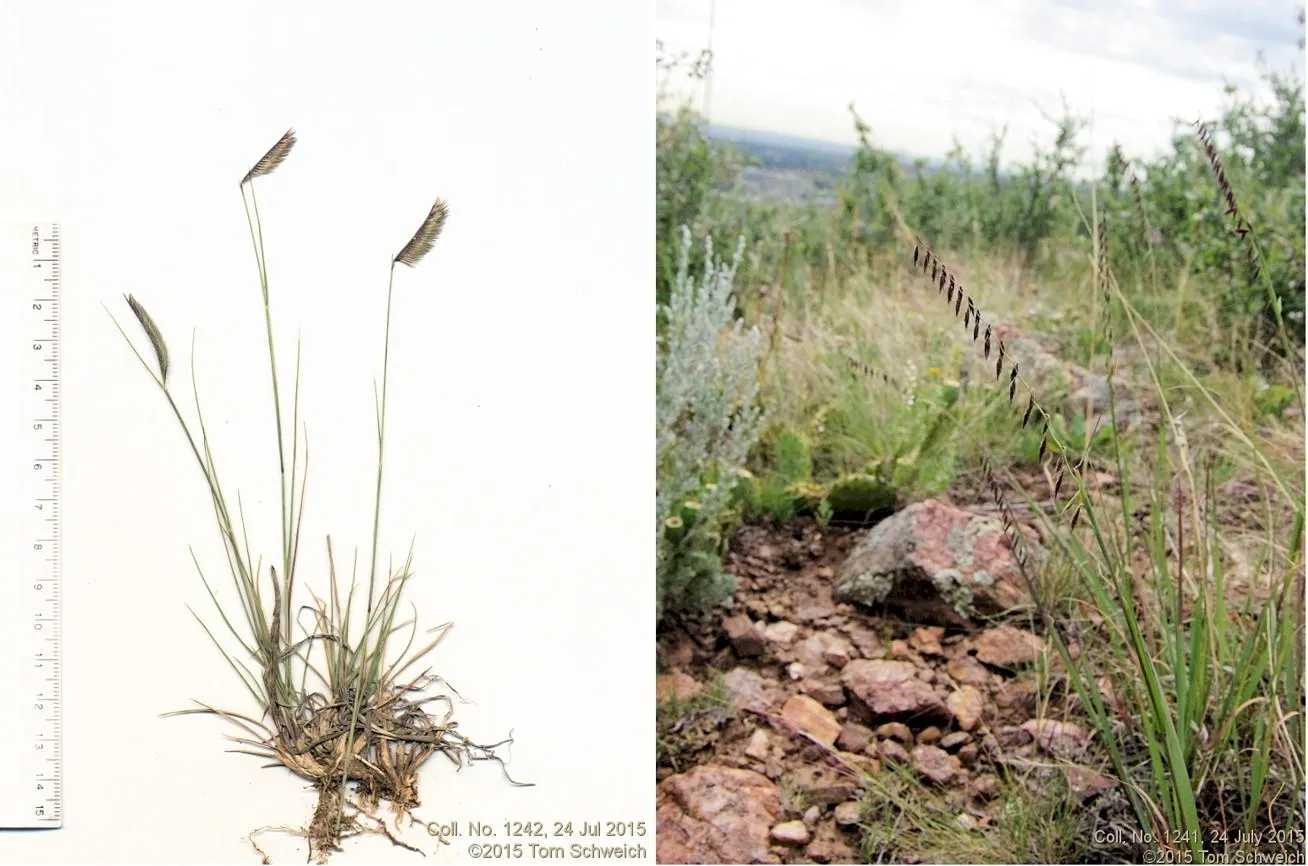
There are two main species of grama grass in Golden. One, blue grama grass – Bouteloua gracilis (Kunth) Lag. Ex Griffiths – is a very common short-grass prairie grass. It has been widely collected around Golden, from Heritage Square in the south to North Table Mountain. The native range of this species is Canada to Mexico.
The first known scientific collection of blue grama was made on “… on the slopes and slopes of the porphyritic mountain La Buffa in Guanaxuato, Mexico (Kunth (1815-1825).” Today we know the mountain as El Cerro De La Bufa, a short walk from downtown Guanajuato, Mexico. The collection was made by the Humboldt and Bonpland expedition to Mexico in 1803 and 1804. This expedition is considered a landmark event in the history of scientific exploration and a crucial contribution to understanding the natural world of the Americas (Wikipedia, 2025). Kunth (1815-25) gave blue grama the scientific name of Chondrosium gracile when he wrote about the results of the Humboldt and Bonpland expedition. Some floras still use that name. The first collection of blue grama in Colorado was made by Charles C. Parry in 1861 somewhere between the headwaters of Clear Creek and Middle Park.
While we typically use the common name of blue grama, our grass is also known as eyelash grass and navajita común. Google translates “navajita” as a razor clam. I had my doubts about Google Translate, but my Spanish-American family confirmed that it could mean both a razor clam or a knife blade, which makes sense because the inflorescence is shaped somewhat like a knife blade.
The other common grama grass in Golden is side-oats grama – Bouteloua curtipendula (Michx.) Torrey. The first scientific name given to side-oats grama was Chloris curtipendula, by Andre Michaux. We met Michaux before, when we discussed Needle and Thread grass. Michaux found side-oats grama in Prairie du Rocher (now in Illinois about 45 miles south of Saint Louis), founded in 1722 by French colonists, mostly migrants from Canada.
Side-oats grama is a perennial, short prairie grass that is native throughout the temperate and tropical Western Hemisphere, from Canada south to Argentina. The specific epithet, curtipendula, comes from Latin curtus "shortened" and pendulus "hanging." While we use the common name of side-oats grama, it is also known as banderilla or banderita (“flag or small flag”).
Side-oats grama has been collected in several places throughout Golden, from Heritage Square to North and South Table Mountain, to Windy Saddle Park, though it is probably in every City of Golden open space. The first Colorado collection was made by George Vasey in 1868 while on Powell’s Colorado Exploring Expedition.
While the grama grasses were given different genus names by their authors, they were united in the genus Bouteloua by Griffiths (1912). David Griffiths’s 1912 monograph on Bouteloua was part of a much larger, long-term effort by the U.S. Department of Agriculture (USDA), especially its Bureau of Plant Industry, and the U.S. National Herbarium at the Smithsonian, to systematically study, classify, and document the grasses of North America in the late 19th and early 20th centuries. The generic name Bouteloua was proposed by Lagasca (1805) to honor Claudio Boutelou, professor, and principal gardener of the Royal Botanical Garden of Madrid, and Esteban Boutelou, his brother, senior gardener at Royal Gardens of Aranjuez, Spain.
References
Griffiths, David. 1912. The grama grasses: Bouteloua and related genera. Bulletin (United States National Museum). Contributions from the United States National Herbarium. 14(3):343-425. https://www.biodiversitylibrary.org/item/113894
Kunth, Carol Sigismund. 1815-1825. Nova genera et species plantarum :quas in peregrinatione ad plagam aequinoctialem orbis novi collegerunt /descripserunt, partim adumbraverunt Amat. Bonpland et Alex. de Humboldt. [New genera and species of plants which they collected in their travels to the equatorial region of the New World /described, partly outlined by Amie. Bonpland and Alexander de Humboldt.] Antverpiae [Antwerp, Belgium], Ex officina Christophori Plantini 7 volumes. https://www.biodiversitylibrary.org/item/11233#page/239/
La Gasca, Don Mariano. 1805. Memoria sobre un genero de la familia de las gramas, llamado Botelua, y sobre otro de la misma familia que le es afine : por Don Mariana La Gasca. [Memoir on a genus of the grass family, called Botelua, and on another of the same family that is related to it: by Don Mariano La Gasca.] Variedades de Ciencias, Literatura Y Artes. [Various (subjects) of Science, Literature and Arts] 2(4):129-. https://babel.hathitrust.org/cgi/pt?id=ucm.5326515049&seq=131
Wikipedia contributors. Alexander von Humboldt. Wikipedia, The Free Encyclopedia. Date retrieved: 15 August 2025. https://en.wikipedia.org/w/index.php?title=Alexander_von_Humboldt&oldid=1303951359