
By Tom Schweich
This winter, warm and dry as it might be, I have written about the evergreens, or plants that keep their leaves through the winter. Of the trees that are evergreen and native in or near Golden, we have previously reviewed the Rocky Mountain juniper — Juniperus scopulorum Sarg. — and the Douglas fir — Pseudotsuga menziesii (Mirb.) Franco.
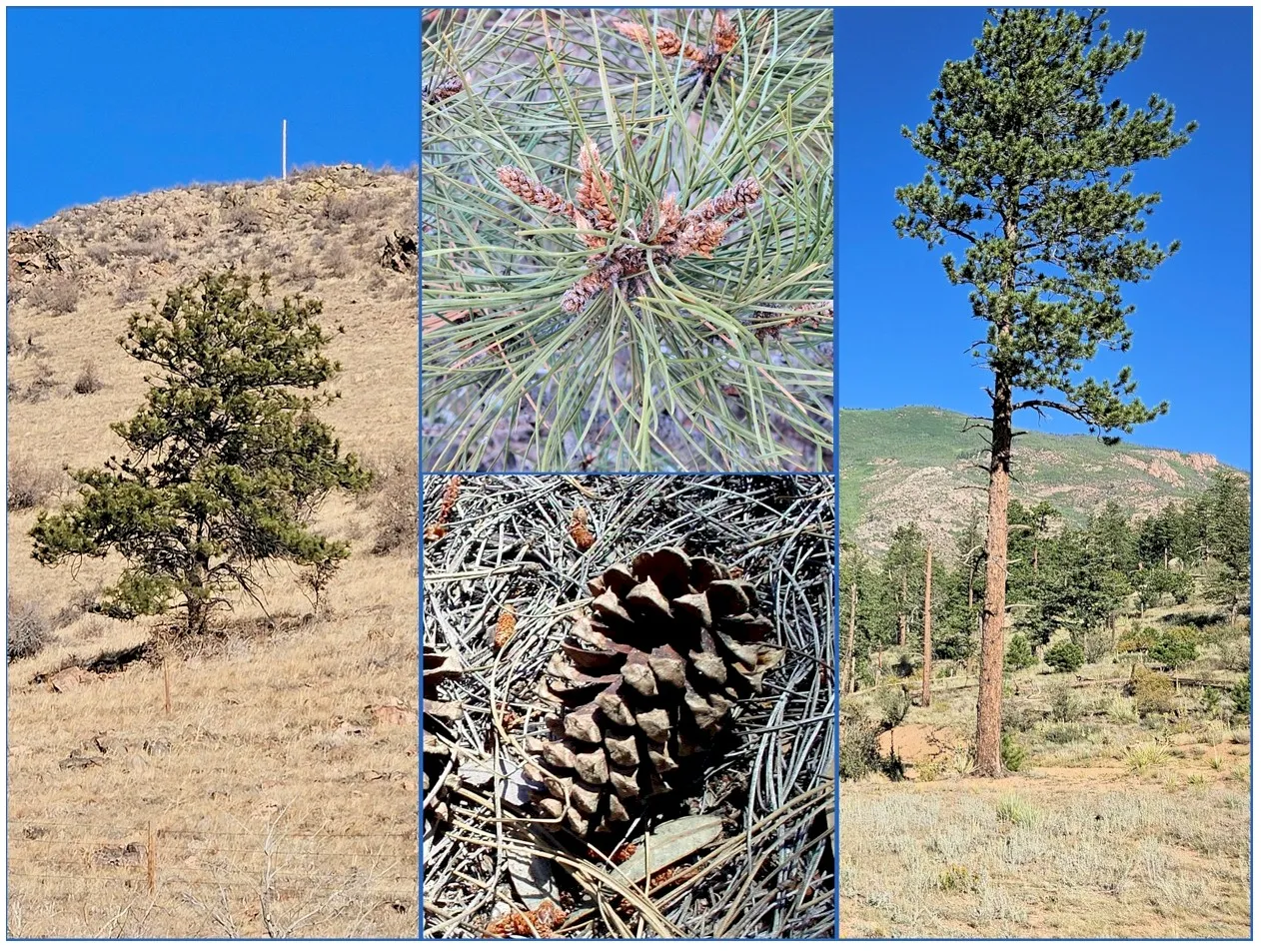
The third native evergreen tree found in Golden is the ponderosa pine — Pinus ponderosa Douglas ex Lawson & C. Lawson — found on the high places around Golden, including North Golden Hogback, Tin Cup Ridge, and Apex Park. There is one tree on top of North Table Mountain near the radio tower, although it is unclear whether it was planted.
The ponderosa pine was one of several trees that David Douglas (1799-1834) introduced into cultivation in England following his second expedition to the Pacific Northwest. Another of Douglas' introductions was the Douglas fir – Pseudotsuga menziesii (Mirb.) Franco. Ponderosa pine was described by Peter Lawson and his son (Lawson & Son, 1836) from plants grown from Douglas’ seeds in pots at Lawson’s Agricultural Museum in Edinburgh, Scotland. This was supplemented by a larger specimen growing in the Caledonian Horticultural Society's Gardens, also in Edinburgh, Scotland. Lawson gave our tree the specific name ponderosa because of the density of the “… timber said to be so ponderous as almost to sink in water …(ibid.)”
Several varieties of P. ponderosa have been described, and those in Colorado are generally known as variety scopulorum Engelmann (Brewer, Watson, and A. Gray, 1880, vol. 2, pg. 126). John G. Lemmon (1897), though, wrote that our Rocky Mountain tree was its own species and proposed the name Pinus scopulorum Lemmon. Some recent genetic evidence supports Lemmon’s assertion (Willyard, et al., 2017). In short, whether our Front Range trees are a variety of the ponderosa pine or a distinct species remains debated, but recent genetics support species status.
“Scopulorum” may sound familiar, in part because we recently wrote about our local large juniper – Juniperus scopulorum Sarg. In a plant name, the Latin term “scopulorum” means "of the cliffs or rocks" or "of rocky places." There are eleven plants that live in Colorado that have scopulorum in some part of their name (see list below).
If we treat our “ponderosa pine” as a separate species from the ponderosa pine of the Pacific northwest, what common name should we use for it? As it happens, Lemmon (1897) had a suggestion, attaching the common name “Rocky Mountain yellow pine” to his scientific name of Pinus scopulorum Lemmon.
Regardless of the name we humans apply to our tree, the tree is host to the mountain pine beetle (Dendroctonus ponderosae), a native insect whose outbreaks, often worsened by climate change, cause massive tree mortality by clogging the tree's vascular system with blue stain fungus (CSFS, 2025). Dry and stressed trees produce less resin, which is the natural defense to beetles. A lack of extreme cold periods in spring or fall has also allowed pine beetles to continue to spread. If Colorado experiences a relatively warm and dry winter followed by a warm, dry spring, the beetles will expand rapidly.
While eradication of the mountain pine beetles is unlikely, the state has formed a task force to address the beetles’ potential impact to watersheds, recreation and infrastructure. The recommendations will include wildfire risk-management strategies, assistance to help landowners pay for wildfire and beetle mitigation, expansion in the use of beetle-killed timber, and funding for research on beetles (Schmelzer, 2025).
References
Brewer, W. H., Sereno Watson, and Asa Gray. 1880. Botany. Geological Survey of California. Volume II. https://www.biodiversitylibrary.org/item/62964#page/147/ The cone-bearing trees were described by George Engelmann, M.D. in a chapter describing all the known western conifers.
CSFS (Colorado State Forest Service). 2025. Mountain Pine Beetle. https://csfs.colostate.edu/forest-management/common-forest-insects-diseases/mountain-pine-beetle/
Lawson, Peter & Son. 1836. The Agriculturalist's manual: being a familiar description of the agricultural plants cultivated in Europe, including practical observations respecting those suited to the climate of Great Britain, and forming a report of Lawson's Agricultural Museum in Edinburgh. Edinburgh: W. Blackwood, 1836. https://www.biodiversitylibrary.org/item/165048#page/374/
Lemmon, J. G. 1897. Three West-American Conifers. Garden and Forest; a Journal of Horticulture, Landscape Art and Forestry. 10: 183. https://www.biodiversitylibrary.org/page/34643249#page/199/
Schmelzer, Elise. 2025. Pine beetles are poised to decimate Front Range forests: ‘Our ability to stop the spread is very limited.’ Denver Post.’ December 22, 2025.
Willyard, Ann, et al. 2021. Phylogenomics in the Hard Pines (Pinus subsection Ponderosae; Pinaceae) Confirms Paraphyly in Pinus ponderosa, and Places Pinus jeffreyi with the California Big Cone Pines. Systematic Botany. 46(3):538-561. https://www.ingentaconnect.com/content/aspt/sb/2021/00000046/00000003/art00002
List of Colorado plants with “scopulorum” in their name.
- Selaginella scopulorum Maxon. Rocky Mountain spikemoss.
- Juniperus scopulorum Sarg. Rocky Mountain juniper.
- Pinus ponderosa var. scopulorum Engelm. (=Pinus scopulorum Lemmon) Rocky Mountain yellow pine.
- Conioselinum scopulorum (A. Gray) J. M. Coult. & Rose. Rocky Mountain hemlock-parsley.
- Artemisia scopulorum A. Gray. Alpine sagebrush.
- Taraxacum scopulorum (A. Gray) Rydb. Harp dandelion.
- Carex scopulorum Holm. Holm's Rocky Mountain sedge.
- Astragalus convallarius Greene var. scopulorum Barneby. Lesser rushy milk-vetch.
- Astragalus scopulorum Porter. Rocky Mountain milk-vetch.
- Pedicularis sudetica Willd. subsp. scopulorum (A. Gray) Hultén. Rocky Mountain lousewort.
- Calamagrostis scopulorum M. E. Jones. Ditch reed grass.
- Delphinium scopulorum A. Gray. Rocky Mountain larkspur.
- Viola canadensis L. var. scopulorum (A. Gray) House. Canadian white violet.


%20Rocky%20Mountain%20Yellow%20Pine)