By Tom Schweich
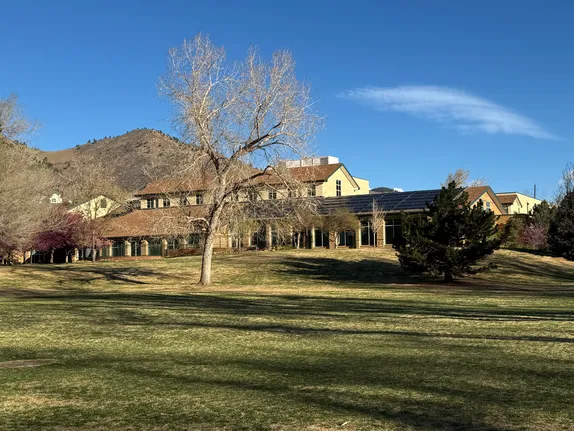
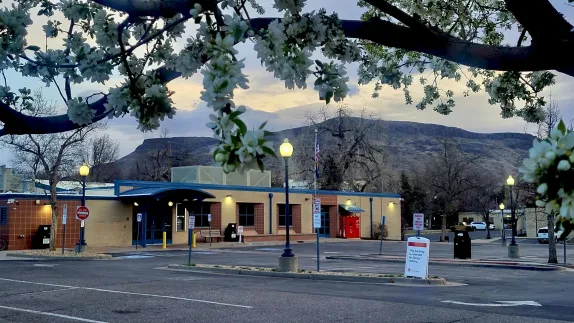
Looking through old, old photographs of Golden, we see the original Golden landscape was prairie — grasses and wildflowers — with the few trees being cottonwoods and willows along Clear Creek and the gulches. With settlement, pioneers and later residents brought trees and planted them around town to make their environment something they considered more pleasant. So many trees were planted that Golden was designated a Tree City by the Arbor Day Foundation in 2000. (Please don’t forget to water your trees during this warm, dry winter spell.)
There are some trees, though, that we would rather not have in Golden. At the time they were brought here, we may have thought it was a good idea. But sometimes a good idea turns out not to be so good after all.
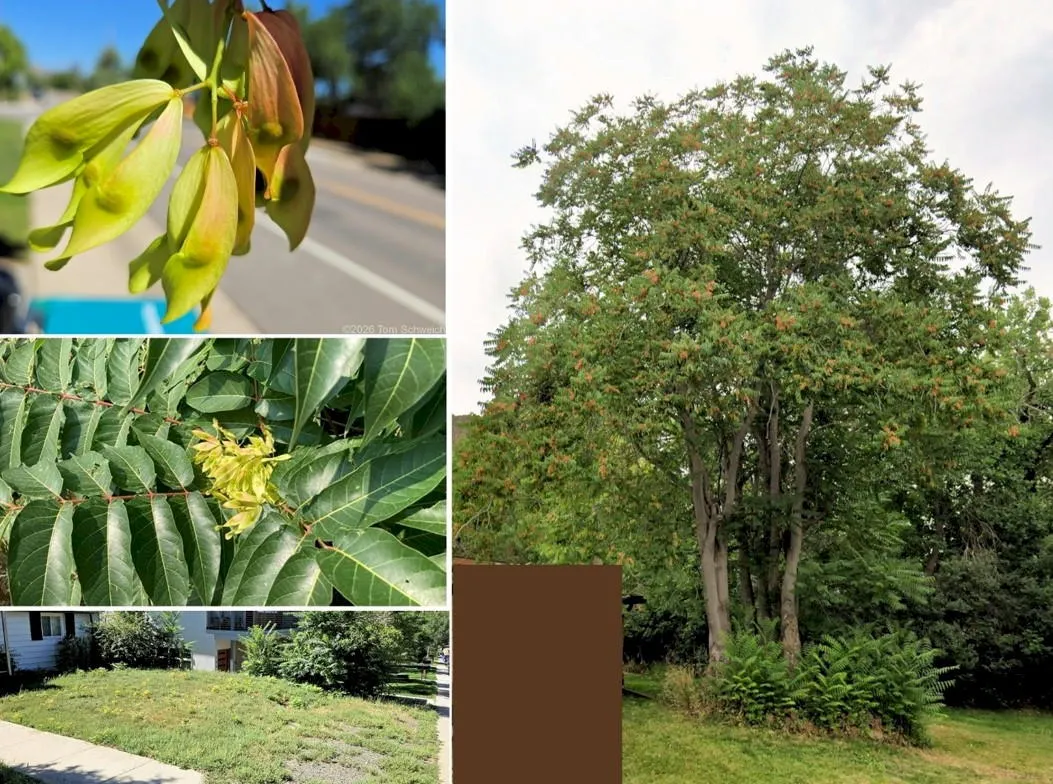
Chief among them is Tree of Heaven — Ailanthus altissima (Mill.) Swingle — a perennial, relatively short-lived deciduous tree, originally from China.
Tree of heaven can grow up to 70 feet tall with a trunk 6 feet in trunk (Miller, 1990). The tree is very adaptable and can grow in areas affected by heat, drought, or pollution and has been troublesome in urban landscapes and woodland. Our tree reproduces by seed but also produces root sprouts that will infest a lawn and can be difficult to eliminate. Some people find the odor of the flowers objectionable.
Tree of heaven is probably the best-known plant in the Quassia family — Simaroubaceae — a small, tropical family known for its content of bitter substances that are responsible for its pharmaceutical properties.
Tree of heaven was brought to California by Chinese immigrants who came during the California Gold Rush of the 1850s. Separately it was introduced to the east coast by William Hamilton, a gardener in Philadelphia. The oldest record in Colorado is in 1934 at a plant nursery in Wheat Ridge (SEINet, 2026). My informal survey found 35 occurrences of tree of heaven in Golden north of Highway 58 (EDDMapS, 2026). There is no survey of Golden south of Highway 58.
The plant grows along roadsides, railways, fencerows, woodland edges, forest openings, or in riparian zones. Its aggressive root system can impact pavement and foundations, the wood is weak and breaks easily, and infestations crowd out native species. The plant has also helped advance the spread of the spotted lanternfly, an agricultural pest also originally from China, but not yet found in Colorado.
Tree of heaven is regarded internationally as a noxious weed due to its ability both to colonize disturbed areas quickly and to suppress competition with allelopathic chemicals. Chemicals produced by the tree proved able to kill nearly 100% of seedlings of many species (Heisey, 1990) and is either lethal or highly damaging to 11 North American hardwood trees and 34 conifers (Mergen, 1959). The tree also resprouts vigorously when cut, making its eradication difficult and time-consuming. This has led to its being called "tree of hell" among gardeners and conservationists.
Tree of Heaven was declared a Colorado List C Noxious Weed on May 15, 2023 (Department of Agriculture, 2023). This means that government agencies are authorized to prevent future sales of tree of heaven and local governments are allowed to focus on management techniques when desired.
References
Department Of Agriculture. 2023. Conservation Services Division. Rules Pertaining to the Administration and Enforcement of the Colorado Noxious Weed Act. 8 CCR 1206-2. eDocket tracking # 2023-00037
EDDMapS. 2026. Early Detection & Distribution Mapping System. The University of Georgia - Center for Invasive Species and Ecosystem Health. Available at http://www.eddmaps.org/; see: https://maps.eddmaps.org/point/eradication/index.cfm?notitle&records=current&sub=3003&zoom=15&lng=-105.22109973&map=distribution&lat=%2039.755543
Google. 2025. Street view of anonymous location, Golden Colorado. 6 February 2026. URL redacted because it identifies location.
Heisey, Rod M. (May 1990). "Allelopathic and Herbicidal Effects of Extracts from Tree of Heaven (Ailanthus altissima)". American Journal of Botany. 77 (5): 662–670.
Mergen, Francois (September 1959). "A Toxic Principle in the Leaves of Ailanthus". Botanical Gazette. 121 (1): 32–36. doi:10.1086/336038. ISSN 0006-8071.
Miller, James H. (1990). "Ailanthus altissima". In Burns, Russell M.; Honkala, Barbara H. (eds.). Hardwoods. Silvics of North America. Vol. 2. Washington, D.C.: United States Forest Service (USFS), United States Department of Agriculture (USDA).
SEINet. 2026. Biodiversity occurrence data published by: SEINet - AZ/NM Node (accessed through the SEINet - AZ/NM Node Portal, https://swbiodiversity.org/seinet, 2026-02-04). https://swbiodiversity.org/seinet/collections/individual/index.php?occid=27215381