By Tom Schweich
Recently we wrote about Tree of Heaven, a tree we would rather not have in Golden. As it happens, there are two other trees we would rather not have. One of them is Russian olive — Elaeagnus angustifolia L.
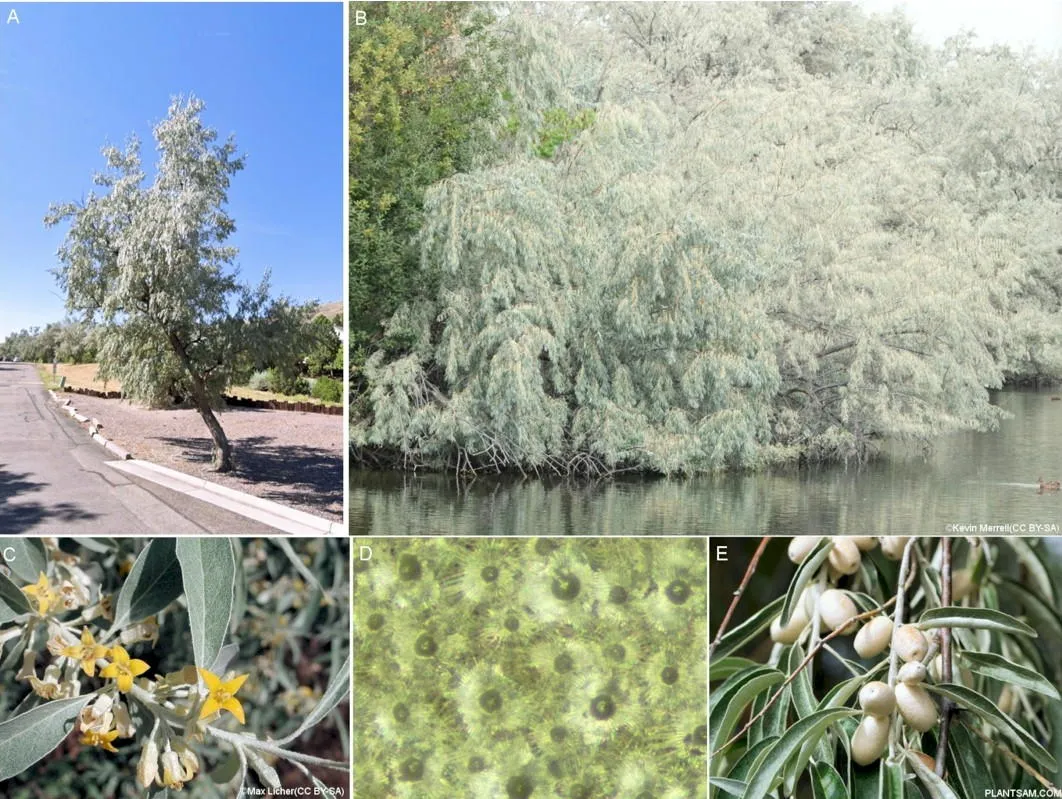
At first glance, Russian olive can look like a good tree. Its narrow silvery leaves shimmer in the wind. It tolerates drought, cold, poor soil, and even salt. It grows quickly, flowers with a sweet fragrance, and produces small olive-like fruits that birds eagerly eat. But in Colorado’s riparian corridors and open spaces, Russian olive is now one of the most damaging invasive trees we have.
Russian olive is in the Oleaster family — Elaeagnaceae — a family of occasionally thorny shrubs and trees that are often silvery in appearance due to the presence of minute parasol-shaped hairs. Several members of this family especially prosper in valley bottoms where the soil surface remains dry, but the water table is not far below. Worldwide, there are 50 species, all native to the northern hemisphere.
The genus Elaeagnus was erected in 1754 by Carl Linnaeus, but there is agreement that the name is based on Theophrastus' (c. 371 - c. 287 BC) use of the Ancient Greek word ἐλαίαγνος (elaíagnos, latinized to elaeagnus) as the name of a shrub. The species name “angustifolia” refers to the leaves that are narrow in width.
Russian olive, though, is not native to North America. It comes from parts of southern Europe, the Middle East, and Central Asia. It was brought to the United States in the late 1800s and early 1900s and widely promoted in the Great Plains and the West as a windbreak tree, making a shelterbelt for farms and towns, and planted for erosion control and “wildlife habitat” (Zouhar, 2005).
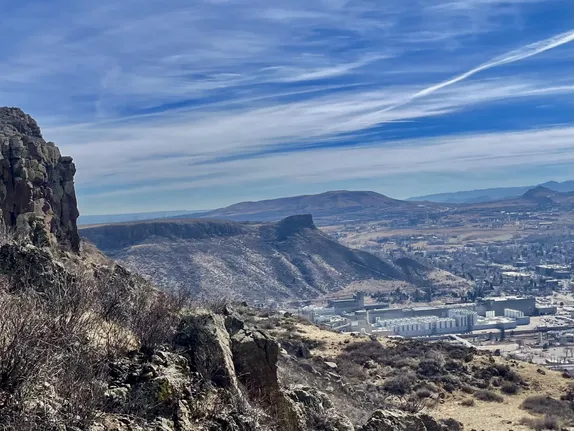
In Colorado, Russian olive was planted around farmsteads, along irrigation ditches, and in towns. From there, birds and floodwaters spread the seeds into nearby creeks and rivers. The oldest record of Russian olive in Colorado was made at Berkeley Park, Denver (Huestis, 1914), although the tree was probably in Colorado well before that date. By the mid-1900s, Russian olive had become naturalized across much of the state. In Golden it can be found as a landscape tree, such as along Heritage Road, and in apartment complexes in north Golden. Russian olive is naturalized in every Golden Open Space and can be found in most of our gulches.
Russian olive does not simply “add another tree” to the landscape. It changes how ecosystems function (Collette & Pither, 2015). Russian olive is a nitrogen-fixing tree. That may sound beneficial, but in Colorado’s naturally low-nutrient riparian soils it is harmful (DeCant, 2008). A soil enriched with nitrogen favors weeds over native plants, alters soil microbes, and makes it harder for native grasses, shrubs, and wildflowers to return. Ultimately Russian olive and its associates will replace native cottonwood and willow forests.
Today Russian olive is a Colorado List B noxious weed (CDA, 2026) meaning that it is targeted for containment, suppression, or eradication to stop their spread. Control requirements for List B weeds are mandated by the state but implemented based on local, county-level plans. Golden is currently working on its Local Noxious Weed Management plan.
On the other hand, Russian olive has been the subject of some interesting research. The leaves are silvery because they are covered by complex hairs that look like tiny shields or parasols. Recent research from China showed how these hairs trap water and direct it into openings in the leaves (Bei, et al., 2023, Fig. 7), so that the tree can obtain water from the air in addition to the soil.
Interesting research aside, Russian olive is a reminder that good intentions do not always lead to good outcomes. We have the opportunity—and the responsibility—to repair that mistake.
What is the third tree we would rather not have in Golden? It is Siberian elm (Ulmus pumila L.), a List C noxious weed, and a topic for another time.
References
Bei, Zhanlin, Xin Zhang, and Xingjun Tian. 2023. The Mechanism by Which Umbrella-Shaped Rachet Trichomes on the Elaeagnus angustifolia Leaf Surface Collect Water and Reflect Light. Biology. 2023(12). https://doi.org/10.3390/biology12071024
CDA (Colorado Department of Agriculture). 2026. Colorado Noxious Weed List (List A, B, and C). https://ag.colorado.gov/conservation/noxious-weeds/colorado-noxious-weed-list
Collette L. K. D., and J. Pither. 2015. Russian-olive (Elaeagnus angustifolia) Biology and Ecology and its Potential to Invade Northern North American Riparian Ecosystems. Invasive Plant Science and Management. 2015;8(1):1-14. doi:10.1614/IPSM-D-14-00037.1
DeCant, Joseph P. 2008. Russian Olive, Elaeagnus angustifolia, Alters Patterns In Soil Nitrogen Pools Along The Rio Grande River, New Mexico, USA. Wetlands 28(4), 896-904, (1 December 2008). https://doi.org/10.1672/07-160.1
Huestis, Wm., 1914. Elaeagnus angustifolia L. Locality: United States, Colorado, Arapahoe, Berkeley Park, Denver. COLO297267. Biodiversity occurrence data published by: SEINet - AZ/NM Node. Accessed 6 February 2026. https://swbiodiversity.org/seinet/collections/individual/index.php?occid=13832611
Zouhar, Kris. 2005. Elaeagnus angustifolia. In: Fire Effects Information System, [Online]. U.S. Department of Agriculture, Forest Service, Rocky Mountain Research Station, Fire Sciences Laboratory (Producer). Accessed 6 February 2026. Available: https://www.fs.usda.gov/database/feis/plants/tree/elaang/all.html