By Tom Schweich
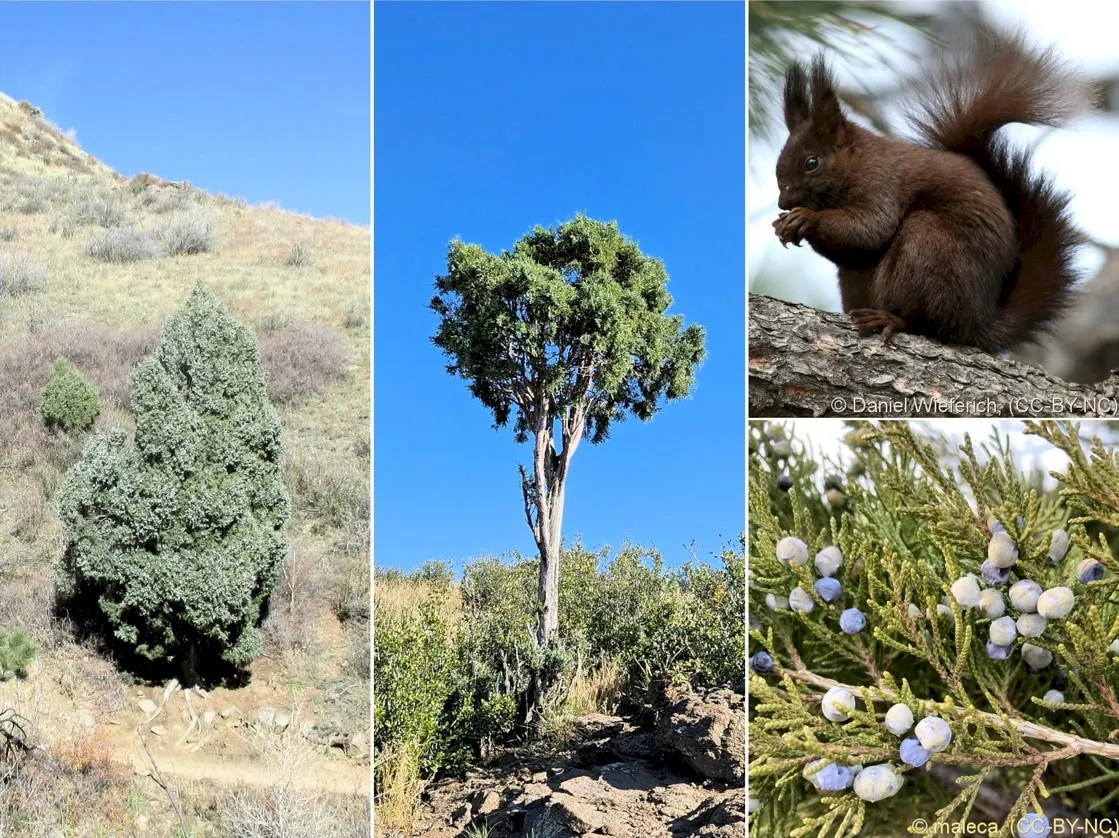
One common evergreen in our Foothills landscape is the Rocky Mountain juniper — Juniperus scopulorum Sargent — on dry slopes, often with sagebrush, pinyon pine, ponderosa pine, or oak communities from 4,000 ft. elevation to 10,000 ft. In Golden, Rocky Mountain juniper is found in all the hilly areas around Golden from Tin Cup Ridge on the south to North Golden Hogback Open Space in the north. The highly visible “Lollipop Tree” on the west rim of North Table Mountain is a Rocky Mountain juniper.
The Rocky Mountain juniper is found as far east as South Dakota and Nebraska, where it is known to hybridize with its eastern relative J. virginiana in the Missouri River basin. To the west, Rocky Mountain juniper is known to occur in Oregon, Nevada, and Arizona, though not California.
Our tree was originally treated as J. virginiana L. or the “Red Cedar,” by Linnaeus (1753) who wrote that it lived in Virginia and Carolina. Charles S. Sargent (1897) recognized Rocky Mountain juniper as a separate species: J. scopulorum. The primary differences between the two species are fruit that matures in 2 years rather than 1 year, a more bluish color, and slightly larger cones. The specific epithet “scopulorum” means “of the rocky cliffs” or “on the rocks.”
The oldest known collection of Rocky Mountain juniper was made by Lewis & Clark (Again!) who wrote, “… found 2nd October 1804. A species of Cedar found on the Blufs (sic), the trees of which are large some of them 6 feet in the girth.” Their location was on the Missouri River, above the mouth of the Cheyenne River, in Dewey or Sully County, South Dakota. While cedars, i.e., trees in the genus Cedrus, are a very different conifer tree, junipers were commonly called cedars in the 19th century and still are in many areas of the country.
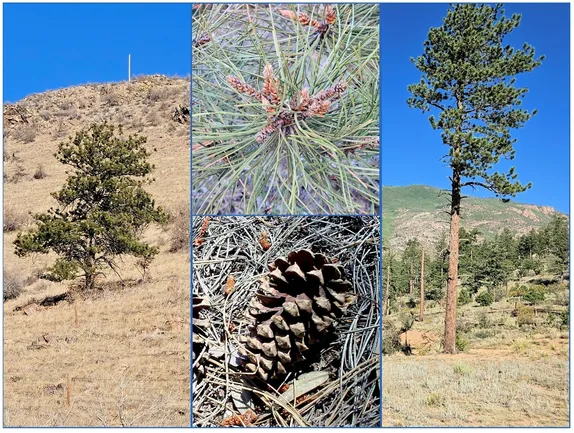
Both "cones" and "berries" are used to describe the fruit of Rocky Mountain juniper. While they are often called "juniper berries," they are not true berries. Instead, they are cones like pine cones. However, pine cones have stiff and prickly scales, whereas the juniper cone scales are soft and fleshy, merging together to give the appearance of being a berry.
Rocky Mountain junipers are often singled out for removal as part of a wildfire risk mitigation program. Junipers are widely considered one of the most fire-prone species due to the presence of highly volatile oils, dense growth habits that trap dead material, and overall fuel characteristics. They are sometimes referred to as "gasoline bushes" by firefighters and are generally recommended to be removed from defensible space zones around structures.
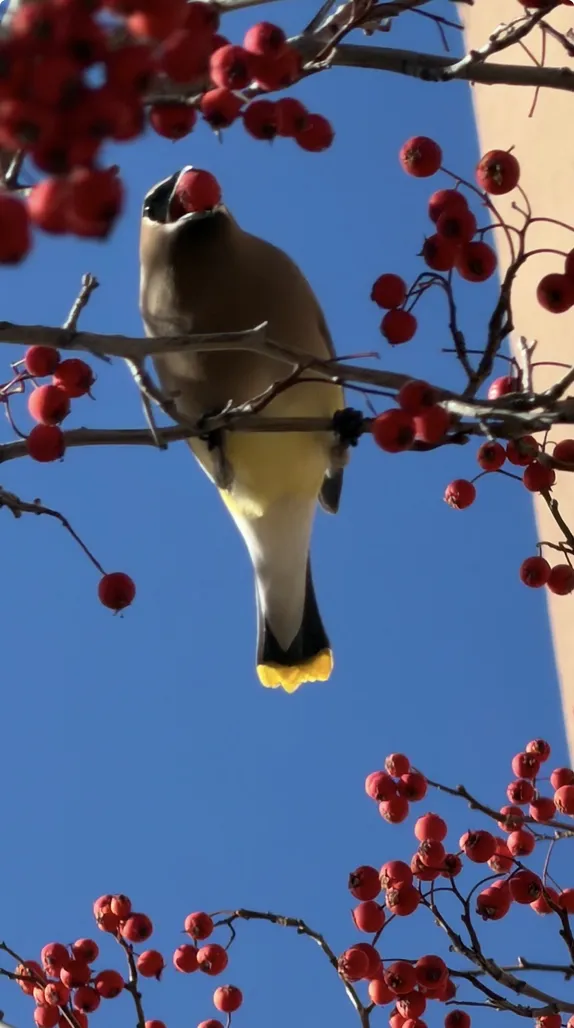
On the other hand, Rocky Mountain junipers provide significant benefits for wildlife. Juniper is particularly valuable for its year-round, multi-purpose support: providing food via "berries," excellent year-round cover and nesting sites for a wide range of birds and mammals, and especially thermal and fawning cover for large herbivores like deer and elk.
Balancing the wildfire risk with wildlife benefits, most ecologists recommend targeted reduction and spacing, such as removing or thinning junipers within 30–100 feet of structures while retaining those farther away, creating mosaics of shrubs and trees, using natural breaks (rock outcrops, grass openings) to separate dense patches, and encouraging mixed stands of native trees and shrubs to reduce overall flammability.
When writing about a native plant found in Golden, I often find myself chasing a minor fact down the rabbit hole. This article is no exception.
The first scientific record of Rocky Mountain juniper in Colorado is Lt. James W. Abert’s (1846) collection that is in the herbarium of the New York Botanical Garden. Lt. Abert was a member of the U. S. Army Corps of Topographical Engineers. He was attached to the Army of the West, under Colonel Stephen W. Kearny, during the U.S. invasion of New Mexico at the outset of the Mexican–American War. In addition to mapping and reconnaissance, his responsibilities would have included natural history observations. Hence Lt. Abert’s collection of Rocky Mountain juniper near Bent’s Fort in 1846. However, the surname “Abert” was familiar to me because Abert’s squirrel (Sciurus aberti) is often seen in Apex Park and other nearby Jefferson County Open Space parks. An hour (or so) of digging though the literature showed that the squirrel was named for Lt. Abert’s father, Col. John J. Abert, who was the Chief of the Corps of Topographical Engineers (Audubon, et al.,1854).
References
Abert, James W. 1846. Juniperus scopulorum Sarg. Specimen collected August 2, 1846, near Bent’s Fort, Arkansas River, Colorado. New York Botanical Garden, Steere Herbarium (NY 18171). SEINet portal: https://swbiodiversity.org/seinet/collections/individual/index.php?occid=2802882
Audubon, John James, John Bachman, and John W. Audubon. 1854. The viviparous quadrupeds of North America. New York, V.G. Audubon, 1851-54. Vol. 3. p. 262. https://www.biodiversitylibrary.org/item/228515#page/274/
Linnaeus [Carl von Linne´]. 1753. Species plantarum :exhibentes plantas rite cognitas, ad genera relatas, cum differentiis specificis, nominibus trivialibus, synonymis selectis, locis natalibus, secundum systema sexuale digestas. [Species of plants: exhibiting plants properly known, related to genera, with specific differences, trivial names, selected synonyms, native places, sorted according to the sexual system] Vol. 2, p. 1039, https://www.biodiversitylibrary.org/page/358861#page/481/
Sargent, Charles Sprague. 1897. Notes of Cultivated Conifers. -- IV. Garden and Forest: A Journal of Horticulture, Landscape Art, and Forestry. 10(505):420. New York: The Garden and Forest Publishing CO., October 27, 1897. Right-hand column about half-way down; see also the photograph on page 423. https://www.biodiversitylibrary.org/page/34643249#page/436/