By Tom Schweich
With Stage 1 water restrictions now a regular part of life in Golden, it makes sense to ask not just how to water our landscapes—but what we should be planting in the first place.
One shrub that checks nearly every box is three-leaf sumac (Rhus trilobata Nuttall ex Torrey & Gray), a tough, adaptable native that already thrives on the hillsides around town
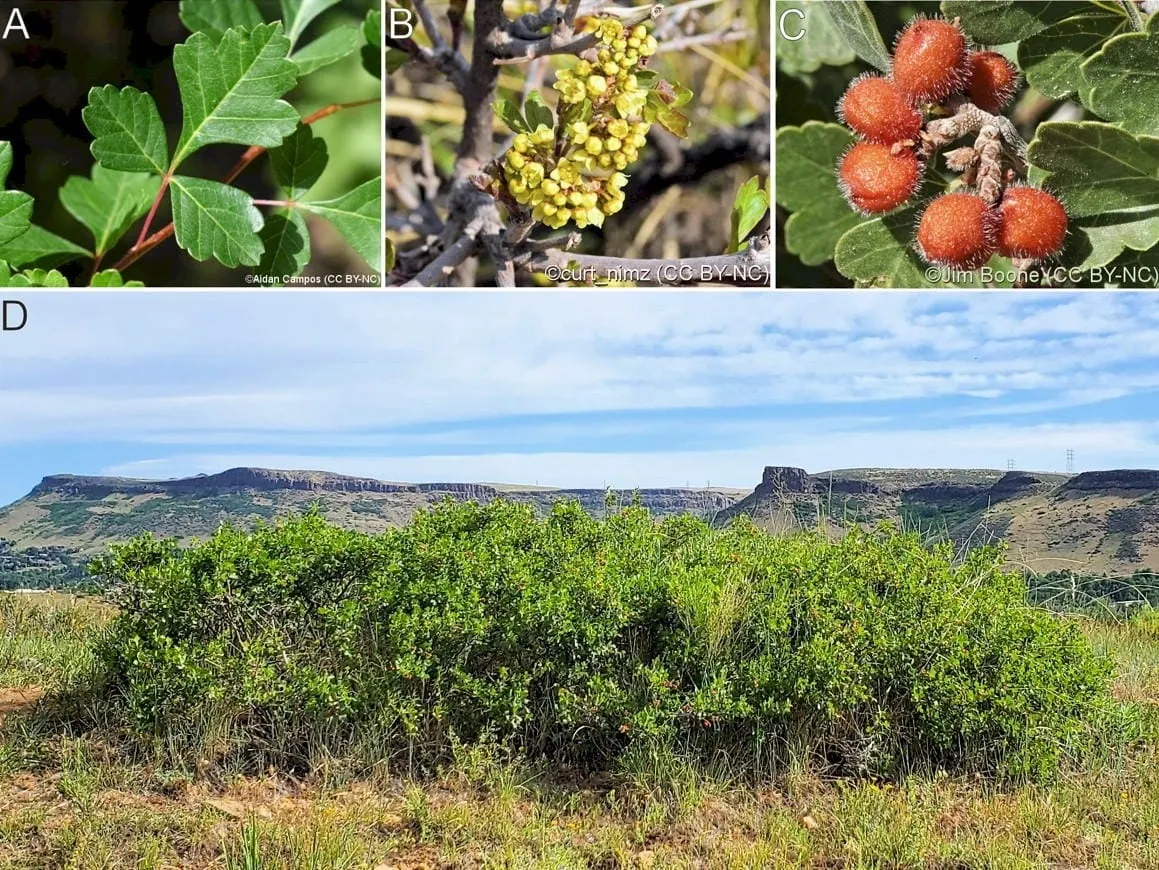
Three-leaf sumac earns its name from its distinctive three-lobed leaves, which emerge glossy green in spring. Small, greenish-yellow flowers appear just as the leaves unfold, followed by clusters of fuzzy red berries on female plants later in the summer. In fall, the shrub turns a brilliant mix of red and orange. Crush the leaves, and you’ll notice the strong scent that gives rise to one of its common names, skunkbush
This is not a delicate plant. Three-leaf sumac ranges from West Texas to California and north through the Rockies into the northern plains. Around Golden, it’s everywhere once you start looking—along trails, on dry slopes, and tucked into open spaces—quietly succeeding without irrigation or care.
It goes by many names: three-leaf sumac, skunkbush, sourberry, and lemonade sumac, a nod to the tart flavor of its fruit. In the Southwest, it’s often called “lemita,” likely derived from limón, reflecting that same citrus quality. An older name, “squawbush,” has rightly fallen out of use.
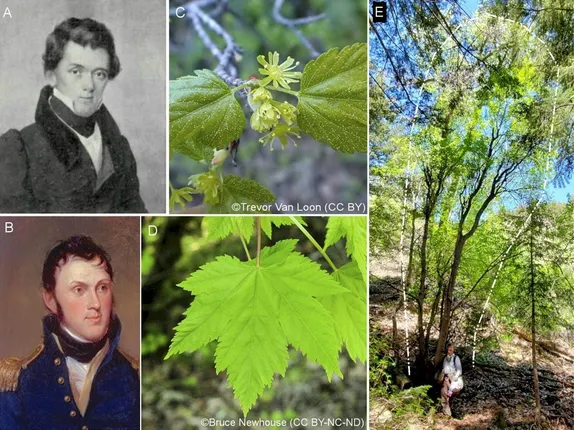
The plant was first collected in the Rockies in 1834 by the botanist Thomas Nuttall during his journey west. His work was later published by John Torrey and Asa Gray (1838), which is why their names remain attached to the scientific name today.
Three-leaf sumac is in the family Anacardiaceae (ana-car-di-A-see-ee), a medium-sized family of flowering plants. It contains about 800 species and is commonly known as the cashew or sumac family. The family is economically significant, containing staples like mangos, cashews, and pistachios.
In the landscape, three-leaf sumac can grow 2 to 8 feet tall in its natural form, but it’s also available in more controlled varieties. ‘Autumn Amber’ stays low—about 1 to 2 feet tall—and spreads outward, making it useful for groundcover or stabilizing slopes. For similar purposes, gardeners often use ‘Gro-Low,’ a related species (Rhus aromatica) that fills much the same niche.
Like many native shrubs, it rewards patience. It may take a couple of years to become established, but after that, it largely takes care of itself.
Three-leaf sumac is often included in fire-wise landscaping lists. While no shrub is fireproof, it tends to hold more moisture and contains fewer flammable oils than many common ornamental plants. Combined with its drought tolerance, that makes it a practical choice in a warming, drying climate (Carter, et al., 2023; Idaho Firewise, 2017).
People have found value in this plant for centuries. Its flexible stems were used in basketry, its berries for dyes, and in some traditions the fruit was mixed with meat and fat to make pemmican. (Anderson, 2004).
In a time when water is limited and conditions are becoming more extreme, planting species that already belong here is a practical step we can take. Three-leaf sumac may not be the showiest shrub at the garden center, but it offers something better: resilience. It has been quietly thriving on the Front Range long before our neighborhoods were built—and it will likely continue to do so long after.
References
Anderson, Michelle D. 2004. Rhus trilobata. In: Fire Effects Information System, [Online]. U.S. Department of Agriculture, Forest Service, Rocky Mountain Research Station, Fire Sciences Laboratory (Producer). https://www.fs.usda.gov/database/feis/plants/shrub/rhutri/all.html
Carter, S., N. Goeckner, C. Julian, L. Langelo, I. Shonle and C. Dennis. 2023. Low-Flammability Landscape Plants. Fact Sheet 6.305. Colorado State University Extension. https://csfs.colostate.edu/wp-content/uploads/2023/05/CSFS_CSU-Ext_Fact-Sheets_LFLP_FINAL_web.pdf
Idaho Firewise. 2017. Fire Resistance of Plants Master Database. https://idahofirewise.org/wp-content/uploads/2017/04/FireXResistanceXofXPlantsXMasterXDatabase.pdf
Torrey, John, and Asa Gray. 1838-1843. A flora of North America: containing abridged descriptions of all the known indigenous and naturalized plants growing north of Mexico, arranged according to the natural system. 1-2. https://www.biodiversitylibrary.org/ item/27717#page/241/